Italian Business Crisis Code: the tools, from the lightest to the heaviest
Italy’s Business Crisis Code offers a ladder of tools. It runs from the internal arrangements that raise the alarm to confidential talks, and from agreements with creditors to the composition with creditors. The earlier you act, the lighter the tool.
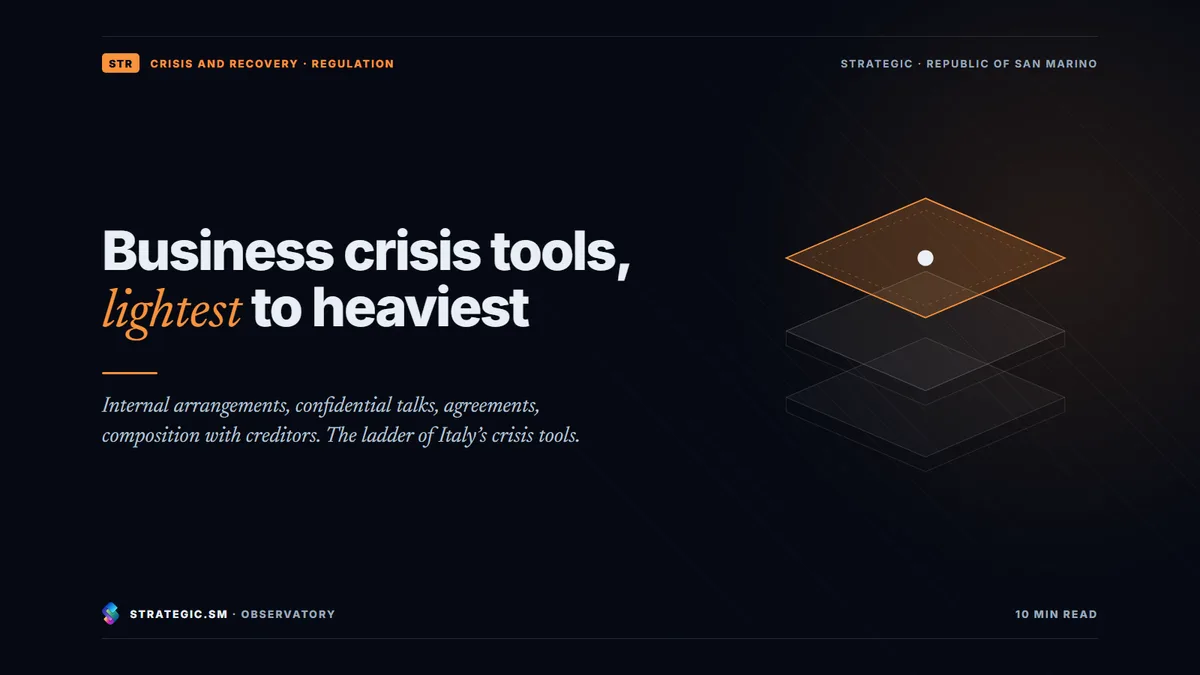
Italy’s Business Crisis Code (Codice della crisi d’impresa e dell’insolvenza, Legislative Decree 14/2019) does not offer a single remedy. It offers a ladder. At the top are the tools a business uses on its own or with a few counterparties, in confidence. These are the internal arrangements that flag problems in time, the negotiated crisis settlement (composizione negoziata) with an expert, and the certified recovery plan. Further down come the agreements with creditors that the court must approve (omologazione), then the composition with creditors (concordato preventivo), which a court supervises. At the bottom is judicial liquidation, which replaced bankruptcy. The practical rule is simple. The earlier you move, the lighter the tool you can use, and the better the company’s chances of carrying on trading. The choice is made with the company’s lawyers and accountants. This article is a map to help you find your way.
When is it time to act?
The Code defines a crisis as the state that makes insolvency likely. It shows up when the expected cash flows are not enough to meet the obligations of the following twelve months. There is no need to wait for the annual accounts to notice. Article 3 lists concrete warning signs:
- salaries overdue by at least 30 days, amounting to more than half of the monthly payroll
- debts to suppliers overdue by at least 90 days and larger than those not yet due
- exposures to banks and other lenders that have been overdue, or above the agreed credit limits, for more than 60 days, if they amount to at least 5 per cent of the total
- debts to INPS (social security), INAIL (workplace injury insurance), the Agenzia delle Entrate (Italy’s tax authority) or its collection arm, the Agenzia delle Entrate-Riscossione, above the thresholds set by law.
For these last debts, the agencies themselves write to the business, and to its board of statutory auditors (collegio sindacale) if it has one. The supervisory body and the external auditor must also tell the directors in writing when the conditions for starting a negotiated settlement are met. On the warning signs that appear before the numbers do, the Observatory has published a guide to the signs of crisis that come before the accounts.
Which tools does the Code offer, at a glance?
| Tool | For whom and when | Court | What it allows |
|---|---|---|---|
| Adequate arrangements | Every business, at all times | No | Spotting the crisis in time and reacting |
| Negotiated settlement | A commercial or agricultural business in financial imbalance, where recovery is reasonably achievable | Only for protective measures and certain authorisations (Articles 19 and 22) | Confidential negotiations with the help of an independent expert |
| Certified recovery plan | A business in crisis or insolvent | No | Private agreements with creditors, protected from clawback actions |
| Standstill agreement | A business that needs to manage the crisis on a temporary basis | Only if someone challenges it | Deferrals that also bind non-signatory creditors in the same category |
| Debt restructuring agreements | A non-minor business in crisis or insolvent | Yes, for court approval | An agreement with creditors holding at least 60 per cent of the claims |
| Restructuring plan subject to court approval | A non-minor commercial business in crisis or insolvent | Yes | Value can be distributed outside the order of priority, if every class of creditors approves |
| Composition with creditors | A non-minor commercial business in crisis or insolvent | Yes, with a court-appointed commissioner | Going concern or liquidation, with a creditor vote |
| Judicial liquidation | A non-minor commercial business that is insolvent | Yes | The sale of assets to pay creditors |
What does the first rung, the internal arrangements, require?
Directors must equip the company with adequate organisational, administrative and accounting arrangements (Article 2086 of the Italian Civil Code, referred to in Article 3 of the Code). In practice, this means a cash flow forecast covering at least twelve months and indicators that compare debts with the ability to pay them. It also means someone who reads those indicators regularly, and a commitment to act when they turn red. This is not a tool for getting out of a crisis. It is what makes it possible to use the next rungs while they are still light.
What is the negotiated settlement, and when is it used?
It is a voluntary and confidential process. Through a national online platform, the business asks the chamber of commerce to appoint an independent expert, who facilitates negotiations with creditors and other interested parties. The platform also offers a practical test to check whether recovery is reasonably achievable. The application includes, among other things, the financial statements, a draft plan, a list of creditors and certificates of tax and social security debts.
The expert’s appointment lasts 180 days from acceptance. Where the law allows, it can be extended by no more than another 180 days. If needed, the business applies for protective measures, which restrict creditors’ actions during the negotiations. The court confirms them for a period of 30 to 120 days, which can be extended up to a maximum of 240 days in total. In that case the application is published in the companies register (registro delle imprese). The negotiations can end with a contract, a standstill agreement or an agreement that the expert also signs. They can also lead on to the other tools.
When is a certified recovery plan enough?
The certified recovery plan (piano attestato di risanamento, Article 56) stays out of court. The business draws up a plan bearing a legally certain date (data certa). The plan describes the causes of the crisis, the strategies, the creditors involved, any new finance and the timetable. An independent professional certifies that the data is accurate and the plan is feasible. Publishing it in the companies register is the company’s choice.
The main advantage concerns the clawback action (azione revocatoria). In a later judicial liquidation, this action can be used to challenge payments made and security granted in the preceding months. Acts, payments and security that implement the plan, and that are listed in the plan itself, are exempt from it, except in cases of wilful misconduct or gross negligence (Article 166). For the plan to work, though, you have to get there before the cash runs out, as our analysis of the certified recovery plan explains.
How do court-approved agreements with creditors work?
Stronger effects require the court’s approval.
- Debt restructuring agreements (accordi di ristrutturazione dei debiti, Article 57). The business reaches an agreement with creditors who hold at least 60 per cent of the claims. The others must be paid in full within 120 days of court approval or of the due date. The threshold is halved, to 30 per cent, in facilitated agreements (accordi agevolati). This applies if the business does not ask the creditors outside the agreement for deferrals and waives protective measures (Article 60).
- Extended-effect agreements (accordi a efficacia estesa, Article 61). If creditors holding 75 per cent of the claims in a homogeneous category sign up, the effects extend to the non-signatories in the same category. This happens only under precise conditions and with a plan that keeps the business going.
- Standstill agreement (convenzione di moratoria, Article 62). With the same 75 per cent threshold per category, deferrals and stays of enforcement also apply to creditors who did not sign. Nobody can be forced to write off part of a claim.
- Restructuring plan subject to court approval (piano di ristrutturazione soggetto a omologazione, Article 64-bis). It allows value to be distributed even outside the order of priority, but it requires the approval of every class of creditors.
When does a business turn to a composition with creditors?
The composition with creditors (Article 84) is the most structured procedure short of liquidation. The business proposes a plan to its creditors, and the plan must give them at least what they would get in a judicial liquidation. It can take two forms:
- going concern (in continuità). It is direct if the business carries on under the same owner, and indirect if it carries on under someone else, for example after a sale or lease of the business
- liquidation (liquidatorio), with the sale of the assets. In that case outside resources are needed. They must increase the assets by at least 10 per cent and ensure that unsecured creditors (chirografari) receive at least 20 per cent of their claims.
The creditors vote, a court-appointed commissioner (commissario giudiziale) supervises, and the court approves. There is also a simplified composition with creditors for the liquidation of assets (concordato semplificato, Article 25-sexies), which is available only after a negotiated settlement. The expert may declare that the negotiations were conducted in good faith but that the other solutions are not workable. The business can then propose it within 60 days of the expert’s final report.
What lies at the bottom of the ladder, and what about minor enterprises?
Judicial liquidation (liquidazione giudiziale, Article 121) applies to an insolvent commercial business that is not a minor enterprise. Minor enterprises (imprese minori) are those that stay within all three thresholds for assets, revenue and debts set by Article 2. They follow the over-indebtedness procedures (sovraindebitamento) instead, with the help of the crisis settlement bodies (organismi di composizione della crisi, OCC). Examples are the minor composition (concordato minore), when it allows the business to carry on, and controlled liquidation (liquidazione controllata).
How do you choose the tool?
A few questions help, and they are best worked through with your advisers.
- How much cash is left? Without a few months of runway, the confidential tools come too late.
- Who are the main creditors? Banks, the tax and social security authorities and suppliers each have different rules and interests.
- Is protection from creditors’ actions needed? If so, protective measures and the court come into play.
- Can the business carry on? With a healthy core, the going-concern tools come first.
- How much confidentiality is needed? Customers and suppliers react when a procedure becomes public.
In companies, the decision to use a crisis resolution tool belongs exclusively to the directors. It must be recorded in minutes drawn up by a notary and entered in the companies register (Article 120-bis).
A typical scenario. An engineering firm loses a major customer, falls behind with its suppliers and receives a warning from the Agenzia delle Entrate over unpaid VAT. With a few months of cash still in hand, it applies for a negotiated settlement and concludes it with a certified plan. A year later, with the cash gone, its options would have been far narrower.
And in San Marino? The Business Crisis Code is Italian law. For San Marino companies the framework is different and must be assessed case by case.
In brief
- The Business Crisis Code offers a ladder of tools. The earlier you act, the lighter the tool available.
- A crisis shows in the cash flows of the next twelve months and in the Article 3 warning signs, before it shows in the accounts.
- The negotiated settlement and the certified plan are confidential and stay largely out of court.
- Restructuring agreements, the standstill agreement and the plan subject to court approval also bind creditors who did not sign, under precise conditions.
- A composition with creditors can be a going-concern or a liquidation procedure. Judicial liquidation is the last rung, and minor enterprises follow the over-indebtedness procedures.
Frequently asked questions
Does the negotiated settlement end up in public registers?
The negotiations are confidential. If the business applies for protective measures, however, the application is published in the companies register together with the expert’s acceptance, and creditors find out about it.
Who decides to start a crisis resolution tool in a company?
The directors, and they alone. The Code requires the decision to be recorded in minutes drawn up by a notary, then filed and entered in the companies register.
Diagnosis, short-term cash forecasting, the plan and relations with the banks are the work of Strategic’s Restructuring and turnaround division. We work alongside your lawyers, your accountants and the independent certifier to choose the tool that best fits where the business stands.
Sources
Consulted on 16 September 2026.
- Legislative Decree 14 of 12 January 2019, Codice della crisi d’impresa e dell’insolvenza (Italian Business Crisis Code), current text, Articles 2, 3, 12, 17, 18, 19, 23, 25-sexies, 25-octies, 25-novies, 56, 57, 60, 61, 62, 64-bis, 74, 84, 120-bis, 121 and 166, Normattiva (in Italian)
- Italian chambers of commerce, Piattaforma nazionale per la composizione negoziata della crisi d’impresa (national platform for the negotiated settlement of business crises, in Italian)
- Italian Civil Code, Article 2086, Gestione dell’impresa (management of the business), Normattiva (in Italian)
 Find out moreRestructuring and turnaroundDiagnosis, short-term cash, a plan and the relationship with the banks for companies under strain or in transition, working alongside the company’s lawyers.