Skip to content

STRATEGICRepublic of San Marino

Contact

Cybersecurity and information security

Cybersecurity for companies and institutions: defences you can test, rehearse and prove

A client asks for proof of your security. The board wants to know where the company stands. Your insurer sends a questionnaire. Strategic tests your systems the way an attacker would (penetration testing) and looks for their known weaknesses (vulnerability assessment). We prepare you to handle an incident and recover from it. And we help you meet the requirements of NIS2, the EU cybersecurity directive, including when you are a supplier to companies that fall under it.

Example graphic: the first hours of a cyber incident, from isolating systems to forensic copies, up to the decision with management and the evidence log.
Example · not a real incident
Fixes in the report
ranked by severity, with the retest agreed with you
NIS2 for suppliers too
documents ready for your clients’ questionnaires
AI systems too
AI assistants and agents among the systems we test

01 · copy the link to this sectionThe situation

The questionnaire arrives before the attack

Under NIS2, documentation carries as much weight as technical testing.

A major client sends a supplier questionnaire. It asks about two-factor authentication, data backups, incident handling and the date of your last penetration test. Your IT team knows almost all the answers. Few of them are written down.

A statement is not enough. You need systems that have been tested, fixes that have been made, and documents that IT, management and clients can all read. Without them, every new request costs weeks, just when a contract depends on those answers.

A technician, seen in profile, at her laptop in front of a server rack in low light.

02 · copy the link to this sectionConsulting

What a cybersecurity consultant does

They show where you are exposed, what to do first and how to prove it.

A cybersecurity consultant helps a company or a public body see where it is exposed and what to do first. Then they help you do it, check it and prove it to clients, the board and your insurer.

What you keep

  • A report that people outside IT can read
  • Priorities, with who does what
  • A plan with dates and owners
  • Evidence for clients, the board and your insurer

External or in-house? An external consultant brings experience from many cases and an independent view, which helps with testing and planning. The person who looks after security every week can be in-house or an outsourced CISO working part time.

03 · copy the link to this sectionWhat we do

Where we come in

Every engagement starts from a written scope. It sets out which systems, which people and which dates.

Example graphic: a penetration test report with the findings ranked by severity, the proposed fix and the status of the retest. CYBTechnical testing

Penetration testing and vulnerability assessment

A vulnerability assessment looks for known weaknesses in your systems and applications. A penetration test then tries to exploit them, as an attacker would, within a scope authorised in writing. The report ranks the fixes by severity. The retest is agreed with you. Penetration testing and vulnerability assessment
CYBIncident response

Incident handling and digital forensics

After an incident, we contain the damage, collect evidence that will stand up, find out how the attacker got in and restart in an orderly way. Before one happens, we prepare a plan, clear roles and exercises with management. Cyber incident response
CYBDisaster recovery Business continuity and disaster recovery Which services cannot stop, and for how long? The answer sets the RTO (the longest acceptable downtime) and the RPO (how much data you can afford to lose, in hours or minutes). Then come isolated backups, a restart order and scheduled restore tests.
CYBNIS2 and personal data

NIS2 readiness and data protection

We compare what you have with what Italy’s National Cybersecurity Agency (ACN, Agenzia per la Cybersicurezza Nazionale) requires. Then come an action plan, procedures for reporting incidents and the documents that prove it. This applies to companies subject to NIS2 and to their suppliers. On personal data, we work with your legal adviser and your DPO (data protection officer). NIS2 readiness
CYBPeople

Training and simulations for staff and leadership

We simulate the most common attempts: repeated phone prompts to approve a sign-in, fake technicians asking for a code, documents shared from accounts posing as a partner. In companies subject to NIS2, the directors must be trained too. We run dedicated sessions for them. Security training for staff
Graphic: a register of artificial intelligence systems showing a blocked request and the reason it was blocked. AIArtificial intelligence

Security of AI assistants and agents

An AI assistant connected to email and documents is tested like any other system. We look for permissions that are too broad, instructions hidden in content and information that ends up in the wrong answer. AI security and governance

04 · copy the link to this sectionReference

NIS2 explained: who it covers and what it requires, in Italy and San Marino

Updated 7 November 2026

In short: NIS2 requires medium-sized and large companies in many sectors to protect their systems and data, to check their suppliers and to report serious attacks within 24 hours. Companies outside its scope often receive its requirements anyway, through a client.

NIS2 is Directive (EU) 2022/2555. In Italy it has applied since 16 October 2024 through Legislative Decree 138/2024 (D.Lgs. 138/2024, Italy’s NIS2 law), and the ACN enforces it.

Timeline of NIS2 notifications in Italy: significant incident, early warning within 24 hours, notification within 72 hours, final report within one month (Legislative Decree 138/2024, Article 25).

In Italy

TopicWhat it means for youReference
Who is in scopeThe law covers organisations in the sectors listed in Annexes I to IV, as a rule medium-sized and large companies. For some activities, such as DNS services, size does not matter.Legislative Decree 138/2024 and ACN FAQs
RegistrationOrganisations register every year from 1 January to 28 February on the ACN portal. The ACN then tells them whether they are on the list.ACN, ‘Ambito e registrazione’ (scope and registration)
LeadershipDirectors approve and oversee the measures, are liable for infringements and must be trained.Legislative Decree 138/2024, Article 23
SuppliersThe security of direct suppliers is one of the mandatory measures.Legislative Decree 138/2024, Article 24
Significant incidentsThey are reported to CSIRT Italia, the national team that responds to cyber attacks. An early warning is due within 24 hours, a notification within 72 hours and a final report within one month. The basic reporting obligation applies from the ninth month after notice of inclusion in the list for organisations added in 2025, and from 1 January 2027 for those added in 2026.Legislative Decree 138/2024, Article 25, and ACN FAQs
DeadlinesOrganisations placed on the list in 2025 have eighteen months for the basic measures, counted from the notice of inclusion. The ACN began sending these notices on 12 April 2025. Those added for the first time in 2026 have until 31 July 2027.ACN Determination 379907/2025 and ACN FAQs

Suppliers to companies subject to NIS2

A supplier does not fall under NIS2 just because its client does. It does, however, receive the client’s requirements: questionnaires, contract clauses, documents and sometimes audits. A supplier falls under NIS2 directly if it carries out one of the listed activities, such as managed IT services, and meets the criteria.

And in San Marino?

NIS2 does not bind San Marino businesses for the work they do within the Republic. It can, however, affect them through what they do in the European Union.

  1. Suppliers to clients in the EU. They receive the same requests as an Italian supplier.
  2. Digital services offered in the EU (managed services, cloud, data centres, DNS and similar). Providers that meet the criteria fall under NIS2 and must designate a representative in a Member State (Directive, Article 26, and Legislative Decree 138/2024, Article 5).
  3. EU Association Agreement. It was signed on 19 October 2026 and was not yet in force on 7 November 2026. It needs the consent of the European Parliament and ratification by San Marino. Its effects will be assessed on the text in force.

For personal data, San Marino applies Law No. 171 of 21 December 2018, the country’s data protection law. Rules still evolving. The proposal of 20 January 2026 to amend NIS2 (COM(2026) 13) was still under discussion on 7 November 2026. This box sets out the rules currently in force.

This box is for information only and is not legal advice. How the rules apply to a particular company should be assessed with its own lawyers.

Sources (consulted on 7 November 2026)

NIS2 readiness, step by stepCybersecurity for companies in San Marino

05 · copy the link to this sectionPublic sector

Cybersecurity for Italian public bodies: what the ACN and NIS2 require

Updated 7 November 2026

In short: some Italian public bodies fall under NIS2 and under Law 90/2024, with measures to adopt and incidents to report. Suppliers to public bodies in scope receive security requirements in tenders and contracts.

WhoWhat is requiredReference
Bodies in the categories of Annex III to Legislative Decree 138/2024The NIS2 rules, whatever their size: security measures, training for leadership, notifications to CSIRT Italia. The categories include regions, metropolitan cities, municipalities with more than 100,000 inhabitants, regional capitals and local health authorities.Legislative Decree 138/2024, Article 3(6) and Annex III
Bodies covered by Law 90/2024Reporting incidents in the ACN taxonomy within 24 hours, with a full notification within 72 hours. A cybersecurity unit and a cybersecurity contact person, who can be the office and the officer in charge of digital transition.Law No. 90 of 28 June 2024, Articles 1 and 8
Suppliers to public bodies in scope of NIS2Security requirements in tenders, contracts and agreements, for supplies signed or renewed after the deadline for the measures.ACN FAQ MSB.12, measure GV.SC-05

What we do for a public body

The work is the same as for a company: risk assessment, technical testing, an incident response plan and training. The rules, the formal acts and the pace of decisions are different. For AI in public offices, there are dedicated courses.

This box is for information only and is not legal advice. How the rules apply to a particular body should be assessed with its legal office.

Sources (consulted on 7 November 2026)

AI training for the public sectorCyber risk assessment

06 · copy the link to this sectionHow we work

From scope to evidence

Four steps. Before any test, we need written authorisation from whoever has legal authority over the systems.

Confidential first conversation and scope

We sign a non-disclosure agreement (NDA) and agree a written scope covering systems, time windows, contact people and exclusions. Every test requires written authorisation from whoever has legal authority over the systems.

Technical assessment

We run tests, review configurations and talk to the people who manage the systems. Anything that could affect production systems is done only at the agreed times.

Example graphic: a penetration test report with the findings ranked by severity, the proposed fix and the status of the retest.

Fixes and retest

We propose fixes in order of severity. The retest is agreed with you.

Over time

We run exercises and new tests at agreed intervals, or whenever your systems or obligations change.

What does it cost, and how long does it take?
It depends on the scope: which systems, how many applications and which dates. The first conversation carries no commitment. If there is work to be done, you receive a written proposal for the initial assessment, usually one or two days of work with the people involved. After the assessment comes the proposal for the project, with phases, timing and costs.
What do you keep at the end?
You keep a technical document for the people who run your systems and a summary for management, written to be discussed by the board.
Who makes the fixes?
For each item, the report says who can carry it out. The order is decided with your IT team, based on severity.

07 · copy the link to this sectionThe first hours

Incident in progress? Three rules that apply to every company

The contact form is not an emergency channel. In the first hours, general guidance applies, consistent with the guides published by the authorities.

Updated 7 November 2026

  1. Isolate, don’t clean up. Disconnect the affected systems from the network. Do not reinstall or delete anything. Shut them down only if you cannot isolate them, because their memory holds useful traces.
  2. Bring the decision-makers together. That means leadership, IT, legal, the DPO and communications. Use channels that do not run through the affected systems.
  3. Keep track of the deadlines. A company subject to NIS2 has 24 hours to send the early warning to CSIRT Italia. If personal data is involved, the supervisory authority must be notified within 72 hours, where feasible. In Italy, that is the Italian Data Protection Authority (Garante).
Sources (consulted on 7 November 2026)

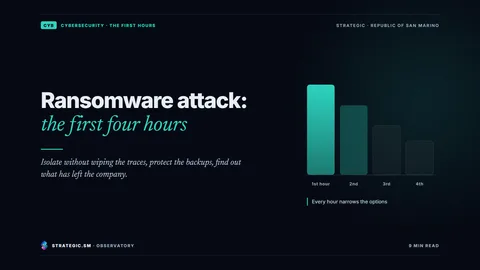
Cyber incident response: first steps and who to notifyThe first hours of a ransomware attack

08 · copy the link to this sectionOutsourced CISO

Outsourced CISO: a part-time head of security

For organisations without an in-house security lead, or that do not need one full time.

The CISO (chief information security officer) is the person who holds an organisation’s cybersecurity together. When you do not have one, Strategic can take on this role part time, under a written engagement.

What the role covers

  • Keeps the security plan and the year’s priorities
  • Reports to management at set intervals, in plain language
  • Handles suppliers, client questionnaires and your insurer
  • Keeps procedures and logs up to date, including for NIS2
  • Organises tests and exercises
  • Coordinates the response when an incident happens

What it does not cover

  • It does not watch your systems in real time
  • It does not replace your IT team or your suppliers
  • It does not decide on behalf of management
  • It does not promise response times that the contract does not set

Days, meetings and the contacts to use during an incident are set out in the contract, before they are needed. Cyber incident response

09 · copy the link to this sectionArtificial intelligence

An AI assistant that reads email and documents can take orders from whoever wrote them

An assistant connected to your email, document archive or ERP reads text, and text can contain orders. An email or an attachment can persuade it to ignore its rules. This is called prompt injection. OWASP’s list of the best-known risks for these systems puts it first. The top ten also include an agent with more autonomy than it needs (excessive agency).

Security testing of assistants that read company data checks four things. In Company Brain projects (the company’s own searchable memory) and AI agent projects, these checks are done before go-live.

  • Permissions are respected.
  • Hidden instructions are rejected.
  • Actions that reach outside the company are approved by a person.
  • A log is available for review.

AI agents and integrations

Example graphic: an email carrying a hidden instruction is blocked before it reaches the AI assistant, and the reason is recorded in the log.

10 · copy the link to this sectionPrinciples

What we don’t do

  • We don’t issue certifications or statements of conformity. We document measures and evidence. Formal assessments are for those with the authority to make them.
  • We don’t test without written authorisation, or outside the agreed scope.
  • We don’t sell a test as a guarantee. It describes the systems tested, on the date it was carried out.
  • We don’t replace your lawyer or your DPO. On notifications, contracts and obligations, we work with them.
  • We don’t disclose test results. They stay with you.
In security, what counts is what you can prove on a given date, not what you claim.

11 · copy the link to this sectionSetting an example

How this website is secured

Anyone who sells security must apply it to themselves as well.

Updated 16 September 2026

  • No profiling cookies and no advertising scripts. Fonts are hosted on this website.
  • An always-encrypted connection and active browser protections (HSTS and Content-Security-Policy), with an address for reporting vulnerabilities (security.txt).

You can check this with your browser’s developer tools.

Cookies and technical tools

12 · copy the link to this sectionFrequently asked questions

Frequently asked questions about cybersecurity

What does a cybersecurity consultant do?
They help a company or a public body see where it is exposed and what to do first. The work covers risk assessment, technical testing such as penetration tests, the incident response plan, business continuity, NIS2 readiness and staff training. At the end you keep a report, the priorities and a plan with owners.
Is an external consultant better than an in-house security lead?
It depends on your size and obligations. A large organisation, or one subject to NIS2, needs someone to look after security every week, in-house or external. An external consultant brings experience from many cases and an independent view. When there is no one in-house, a part-time outsourced CISO holds the work together. Outsourced CISO
How much does cybersecurity consulting cost?
It depends on the work and the scope: a test, a plan or support over time. That is why there is no price list. The first conversation carries no commitment. If there is work to be done, you receive a written proposal for the initial assessment, usually one or two days of work with the people involved. After the assessment comes the proposal for the project, with phases, timing and costs.
Can a San Marino company test the systems and data of Italian companies?
Yes, on the same terms as any other supplier. We need written authorisation from whoever has legal authority over the systems, because unauthorised access to a computer system is a crime in Italy (Article 615-ter of the Italian Criminal Code). Any personal data is covered by an agreement under the GDPR. We work remotely and, when needed, on site.
Do you work across Italy or only in San Marino?
Across Italy. Strategic is based in San Marino and also works on site in Romagna, the Marche and Emilia. With companies and public bodies in the rest of Italy, we work remotely.
Does NIS2 apply to a San Marino company?
Not to the work it does within the Republic. It can apply in two cases. The first is when the company supplies clients in the EU that fall under NIS2, because they ask their suppliers for assurances. The second is when it offers digital services covered by the Directive in the EU, such as managed services or cloud. In that case it designates a representative in a Member State. Cybersecurity for companies in San Marino
Do you also work with small and medium-sized businesses?
Mainly with established organisations. A smaller business can also write to us when the work involves systems integration, security or a sensitive phase for the company.
What should we do if an attack is in progress?
First isolate the affected systems without cleaning them up, bring the decision-makers together and keep track of the notification deadlines. Then write to us through the form and choose ‘It’s urgent’. Your request will be flagged, although the form is not an emergency channel. Cyber incident response

13 · copy the link to this sectionObservatory

From the Observatory: cybersecurity

Analysis, guides and ‘first hours’ briefings on company security from the Strategic editorial team.

All cybersecurity articles

The essential parts of this page print as a short summary of a few pages, without images or invitations to get in touch.

14 · copy the link to this sectionContact

Write to us about your company’s security

A few lines are enough: what kind of company you are, what needs testing or what has happened, and any deadlines. We reply by email, usually within two working days.

We work on site in San Marino, Romagna, the Marche and Emilia, and remotely anywhere in Italy. Where we work

Please do not put credentials, IP addresses or vulnerability details in the form. We exchange them later, over the channels we agree. If an incident is in progress, see The first hours for initial guidance.

On WhatsApp, messages are answered by Strategic’s AI assistant. Please do not use it for confidential information.

Your requestCYBCybersecurity

Do any of these questions sound familiar? tick the ones that apply to you

The form opens with the topic and the questions already filled in.