Signs of a business crisis: what comes before the annual accounts, and what the law says
Payments go to whoever pushes hardest, suppliers ask for money up front and banks grow cautious. These signs of crisis appear months before the accounts. Here are the four indicators set by law and ten self-assessment questions.
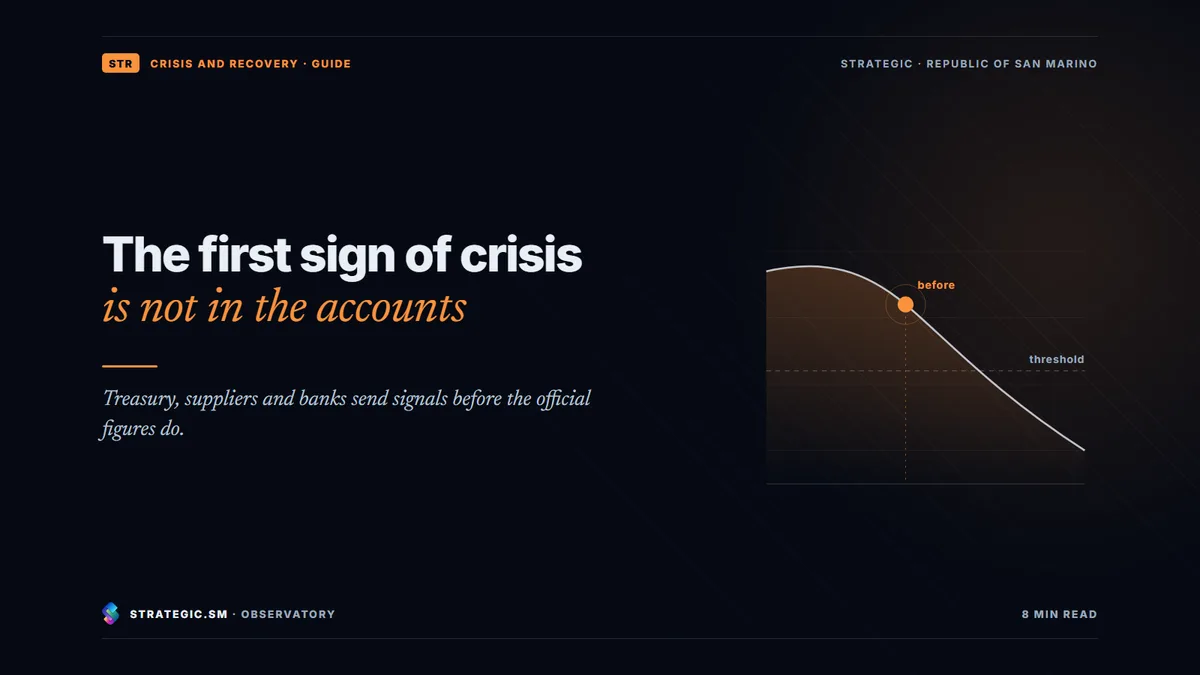
The first signs of a business crisis appear months before the annual accounts. Payments go to whoever pushes hardest. Customers pay later and later. Suppliers ask for money up front. Banks want more collateral when the credit line comes up for renewal. Since 2022 Italian law has also set out four specific warning signs, linked to wages, suppliers, banks and public bodies. Companies that read them in time still have the lightest tools available to bring the business back into balance.
A typical scenario. The accountant calls more often than usual, “just for a chat”. The budget meeting is postponed for the third time. The long-standing supplier asks for payment in advance, “just for this order”. None of these episodes says much on its own. Together they say almost everything. When the accounts finally arrive, they describe a year that is already over.
What does the law mean by a crisis?
Under the Italian Business Crisis Code (Codice della crisi d’impresa e dell’insolvenza), a crisis is the state that makes insolvency likely. It shows itself in forecast cash flows that are not enough to pay the debts falling due over the next twelve months (Article 2). The definition looks forward, not back. A profit in the accounts is not enough to rule out a crisis if cash over the coming months will not hold up.
The Italian Civil Code adds a specific duty. Directors must give the company organisational, administrative and accounting arrangements that are adequate, among other things, to detect a crisis in time. When they detect one, they must act without delay (Article 2086). Reading the signs is therefore more than prudence. It is part of the job of running the business.
Which signs come from inside the company?
These are the signs everyone notices and no one puts together.
- Treasury chases emergencies. Whoever pushes hardest gets paid, not whoever falls due first. When payments stop following a plan, the problem is not just liquidity. It is control.
- Customers pay later and later, and no one complains, because turnover is “holding up”.
- Investments are postponed “to be on the safe side”, with no date set.
- The budget is revised several times in the same year, always downwards.
- The monthly close slips, and the figures arrive when they are no longer useful.
- Management asks different questions. It no longer asks “how do we grow?” but “how solid are we?”
When the leadership stops talking about growth and starts talking about holding on, the crisis is already in the room, even if the accounts do not show it yet.
Which signs come from outside?
Other signs depend not on how the company sees itself, but on how others see it.
- The bank asks for more collateral on credit lines it used to renew without discussion. It has already made its assessment and written it into the terms.
- Suppliers shorten payment terms or ask for payment in advance. Often the credit insurer is behind this, having cut the credit limit it grants the supplier on that customer. The information is not public, but it reaches the people who sell on credit before it reaches the customer’s own board.
- The best people start looking around. They sense the tension before anyone admits it.
- Social security contributions and tax payments slip, and sooner or later a formal warning arrives.
A practical tip. A company can ask the Bank of Italy for its own data in the Central Credit Register (Centrale dei rischi), the same data the banks see. There is no fee, and the company can also subscribe to receive the data every month. It is a simple way to find out how the banking system sees the business.
What warning signs does the law set out?
The Business Crisis Code (Article 3(4)) lists four signs that the company’s organisational arrangements must bring to light.
| Area | The sign set by law |
|---|---|
| Wages | Wages overdue by at least thirty days, amounting to more than half of the total monthly payroll |
| Suppliers | Debts overdue by at least ninety days, exceeding the amount of debts not yet due |
| Banks | Exposures overdue by more than sixty days, or a credit limit exceeded for at least sixty days, if they amount to at least 5% of total exposure to banks and other lenders |
| Public bodies | Debts to INPS (social security), INAIL (workplace injury insurance), the Agenzia delle Entrate (Italy’s tax authority) or its collection arm, the Agenzia delle Entrate-Riscossione, above the thresholds that oblige these bodies to notify the company |
Alongside these, two other mechanisms can raise the alarm from outside the management team. The supervisory body, for example the board of statutory auditors (collegio sindacale), must report in writing to the directors when the conditions for a negotiated crisis settlement (composizione negoziata, an out-of-court procedure) are met (Article 25-octies). And the qualified public creditors, meaning the bodies in the table, send a formal warning when debts exceed the legal thresholds (Article 25-novies).
The national negotiated settlement platform, run by Italy’s chambers of commerce, also offers a practical test to check whether recovery is reasonably achievable.
Self-assessment: ten questions for the board
- Is there a cash forecast for the next twelve months, updated within the last month?
- Do you know today in which week cash will be at its lowest?
- Has the average number of days it takes customers to pay risen over the last year?
- Are there supplier debts more than ninety days overdue? For how much?
- Have wages, social security contributions and taxes all been paid on time?
- Has any supplier asked for advance payment or security in the last six months?
- Has the bank asked for new collateral or for information outside the usual schedule?
- Has this year’s budget been revised more than once?
- Does anyone in the company have the job of putting these signs together and reporting to the board?
- Do you know which tools under the Business Crisis Code would still be available, and until when?
More than two uncomfortable answers are a good reason to stop and take a proper snapshot of the finances.
Why is waiting for the numbers so costly?
The signs are not missing. The problem is that people wait for numerical confirmation before acting, and meanwhile the options narrow. Action taken months ahead has tools that late action no longer has. You can negotiate with the banks from a position that is still credible. You can use a certified recovery plan (piano attestato di risanamento) while creditors are cooperating. You can use the negotiated crisis settlement with an independent expert while recovery is still reasonably possible.
Sometimes the numbers hold up but the company is stuck all the same, because three shareholders can no longer decide together. That is a crisis too, and if it lasts it reaches the accounts.
Where does artificial intelligence help?
Many of the signs are already in the company’s systems, in the ERP system, bank statements, payment schedules and payroll. The problem is that no one puts them together every week. Where the systems allow it, an artificial intelligence integration can calculate the indicators regularly, update the cash forecast and send an alert when a value approaches a threshold. Assessments and decisions stay with people. The data stays where the company decides. How these tools connect to existing systems is explained on our page on AI agents and integrations.
What about San Marino? The Business Crisis Code is an Italian law. For San Marino companies the framework needs to be assessed case by case.
In brief
- In law, a crisis looks forward. What counts is cash over the next twelve months, not last year’s profit.
- Internal and external signs arrive months before the accounts. They come from treasury, collections, suppliers, banks and people.
- The Business Crisis Code sets four warning signs, on wages, suppliers, banks and public bodies.
- The supervisory body and public creditors can raise the alarm even when management does not.
- The sooner you act, the more light and confidential tools remain available.
Frequently asked questions
Does a profit in the accounts rule out a crisis?
No. The definition of crisis looks at forecast cash for the following twelve months. A profitable company may lack the liquidity to pay debts as they fall due, for example if customers pay very late or if it has funded investment with short-term loans.
Who should spot the signs?
The board of directors comes first. By law it must have arrangements adequate to detect them. The supervisory body, where there is one, has a duty to report. In practice you need one person whose specific job is to put the data together and report to the board regularly.
What happens if a warning arrives from INPS or the Agenzia delle Entrate?
The warning tells the company that its debts have exceeded the legal thresholds. It invites the company to consider the tools for dealing with a crisis, starting with the negotiated crisis settlement. Treat it as an alarm to take straight to the board, with your accountant.
Where do you start when the signs are there?
Start with an honest snapshot. That means a twelve-month cash forecast, debts by due date and by creditor, and margins by product and by customer. On that basis, with your accountant and lawyers, you assess which tool is still available.
Putting the signs together before the accounts do it for you is the first step of the work described on our page on restructuring and turnaround. It covers a written diagnosis, a cash forecast and the choice of tool, together with the company’s own advisers.
Sources
Consulted on 16 September 2026.
- Legislative Decree 14 of 12 January 2019, Italian Business Crisis Code (Codice della crisi d’impresa e dell’insolvenza), Normattiva, Articles 2, 3, 13, 25-sexies, 25-octies and 25-novies (in Italian)
- Italian Civil Code, Article 2086, Normattiva (in Italian)
- Bank of Italy, Access to Central Credit Register data (in Italian)
- National online platform for the negotiated settlement of business crises, chambers of commerce (in Italian)
 Find out moreRestructuring and turnaroundDiagnosis, short-term cash, a plan and the relationship with the banks for companies under strain or in transition, working alongside the company’s lawyers.