Italy’s certified recovery plan: how it works and why timing matters
The certified recovery plan is one of the lightest tools in the Italian Business Crisis Code, and the only one that stays entirely out of court. But it holds only while banks and suppliers cooperate. What the law provides, how it compares with the other tools and the mistakes that make it fail.
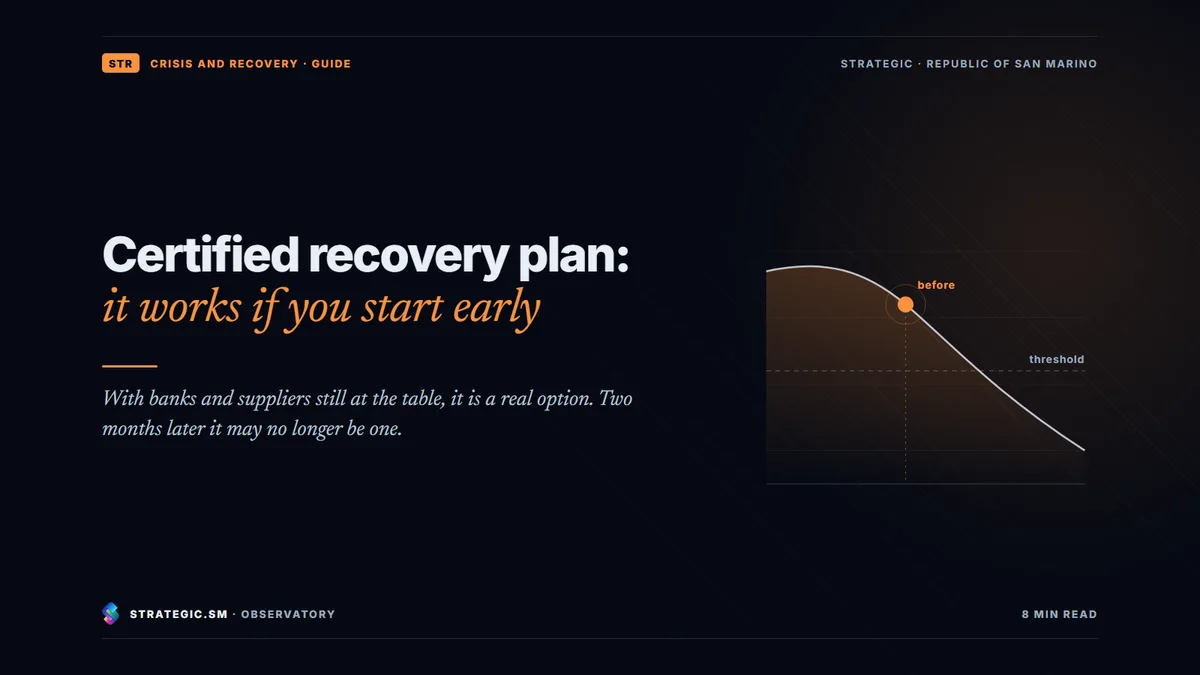
The certified recovery plan (piano attestato di risanamento), governed by Article 56 of the Italian Business Crisis Code (Codice della crisi d’impresa e dell’insolvenza, CCII), is one of the lightest tools for getting out of a crisis. It is also the only one that stays entirely out of court. The company writes a plan, an independent professional certifies its figures and feasibility, and the main creditors accept it, all without going before a judge. It works only if banks and suppliers are still willing to cooperate. That is why, when choosing among the tools, the moment you start matters more than how bad the numbers are.
A typical scenario. In January a company sees its banks cut its credit lines and a key supplier demand payment in advance. Inside the company, the decision is to “keep an eye on the situation”. By March the credit line has been closed. Two suppliers have handed their claims to a debt collection agency, and the first payment injunctions (decreti ingiuntivi) have arrived. In January a certified recovery plan was a workable route. By March, the tools left are slower, more public and more expensive.
What is a certified recovery plan?
A certified recovery plan is an agreement between the company and some of its creditors. It rests on a written plan checked by an independent professional. It is open to a business owner in a state of crisis or insolvency. In plain terms, these are its elements:
- the plan, bearing a legally certain date, describes the company’s situation, the causes of the crisis, the actions to get out of it, the timetable and the creditors involved
- the certifier (attestatore), an independent professional who meets the requirements set by law, checks that the company’s figures are true and that the plan is feasible
- the agreements with the creditors who sign up, for example the banks and the main suppliers
- publicity, meaning that the plan and the agreements are published in the companies register (registro delle imprese) only if the company asks for it.
The main advantage is a form of protection. The company might later end up in judicial liquidation (liquidazione giudiziale), which has replaced bankruptcy (fallimento) since 2022. If so, the acts, payments and security interests carried out to implement the plan are not subject to clawback actions (azione revocatoria, Article 166(3)(d)). The protection does not apply in cases of wilful misconduct or gross negligence by the certifier, or by the debtor where the creditor knew of it.
The certified plan also has limits, and they should be stated straight away:
- it binds only those who sign it, so creditors who do not join can still take action
- it does not provide automatic protective measures against enforcement action
- no judge oversees its implementation, so whether it holds depends on how sound the plan is and on the creditors’ trust.
When is it better than the other tools?
The useful question is not which tool is best in the abstract. It is which one fits the state of the crisis at that moment. Here is a comparison, in the order in which companies usually come across them:
| Tool | Court | Creditor consent | Confidentiality | When it makes sense |
|---|---|---|---|---|
| Negotiated crisis settlement (composizione negoziata, Articles 12 and following) | Only for protective measures and certain authorisations (Articles 19 and 22) | Negotiation assisted by an independent expert | Confidential, but the application for protective measures is published | You need a framework, and time to negotiate with many creditors |
| Certified recovery plan (Article 56) | No | Only those who sign up | Confidential, unless the company asks for publication | The crisis is reversible and the main creditors still cooperate |
| Debt restructuring agreements (accordi di ristrutturazione, Articles 57, 60 and 61) | Yes, for court approval (omologazione) | At least 60% of claims (30% in facilitated agreements) | Public | Broad but not unanimous consent |
| Composition with creditors (concordato preventivo, Articles 84 and following) | Yes | Creditors vote, and an approved proposal also binds those who voted against | Public | Voluntary consent is no longer enough |
In ordinary debt restructuring agreements, creditors who do not sign up must be paid in full, normally within 120 days. Under agreements with extended effect (Article 61), the effects can also be extended to non-signing creditors in the same category, under precise conditions. A standstill agreement (convenzione di moratoria, Article 62), by contrast, allows debts owed to one category of creditors, such as the banks, to be suspended or rescheduled.
One point is often misunderstood. In a composition with creditors, the court does not impose a solution on the majority. It is the other way round. The proposal approved by the majority, once the court has approved it, also binds the minority that voted against.
Why is time the real deciding factor?
Many business owners reason by severity. “The crisis is serious, so we need the strongest tool.” That is a mistake. The deciding factor is how much room for manoeuvre is left with the creditors.
A company with heavy losses, but with banks and suppliers still willing to talk, can work within a certified plan. A company with less dramatic numbers, but with creditors already in court and payment injunctions served, needs a tool with court protection, whatever the accounts say on paper.
The right question is not how bad things are at the company. It is who is still answering. If the banks reply to emails and the main suppliers agree to a meeting, there is probably still time for the lighter routes.
What does it take for a certifier to sign the plan?
A serious certifier will not sign a plan built on optimistic projections. Before you call one in, it is worth having these ready:
- an up-to-date statement of assets, liabilities and financial position, not the one from the last annual accounts
- a cash flow forecast covering at least twelve months, with the assumptions written down
- an analysis of the causes of the crisis, because a plan that does not tackle them is not credible
- the concrete actions, such as costs to cut, assets to sell, prices to review and product lines to close
- a list of debts by creditor and due date, with the proposal to each one
- any new financing, and who is providing it
- a worst-case scenario, to show that the plan holds even if something goes wrong
- the consequences for employees.
The work is divided by role. The company builds the figures and the plan with its accountant, its lawyers and any adviser it has. The certifier checks them independently. Among other things, the Code requires that the certifier has not worked for the company in the last five years.
Which mistakes make a certified plan fail?
- Arriving late, when creditors have already stopped waiting. A well-written but late plan is useless, because its strength depends on the consent that remains.
- Projections built to reassure rather than to withstand scrutiny.
- Involving only the banks, and forgetting the suppliers without whom the company cannot produce.
- Not following through on implementation. Without regular checks on variances, the plan drifts away from reality and nobody notices.
For that last point, a cash flow forecast updated at regular intervals is everyone’s working tool. Where the systems allow it, artificial intelligence can read receipts and payments from the ERP system and bank statements, which cuts the manual work. The checks stay with people. Whoever leads the implementation, often with a Chief Restructuring Officer alongside management, must spot every variance early.
In brief
- The certified recovery plan (Article 56) is out of court and confidential. It rests on a written plan, an independent certification and the agreement of the main creditors.
- It shields acts carried out to implement the plan from clawback actions, but it binds only those who sign it.
- It works if banks and suppliers are still cooperating. Timing matters more than how bad the numbers are.
- In a composition with creditors, the majority of creditors binds the minority, not the other way round.
- The Business Crisis Code is Italian law. For businesses in San Marino the framework must be assessed case by case.
Frequently asked questions
Does a certified plan stop creditors from taking action?
No. It binds only the creditors who sign the agreements, and it provides no protective measures. If a major creditor does not sign up and goes to court, it is worth looking, with your lawyers, at a tool that offers protection. Examples are a negotiated crisis settlement with protective measures, or a debt restructuring agreement.
Does a certified plan have to be filed with the court?
No, it is an out-of-court tool. The plan, the certification and the agreements can be published in the companies register, but only if the company asks for it.
Who can act as certifier?
It must be an independent professional who meets the requirements of Article 2 of the Business Crisis Code. The certifier must be entered in the register of statutory auditors and in the official list of business crisis managers. They must have no ties to the company that could compromise their judgement, and no engagements for the company in the last five years.
Can a negotiated crisis settlement lead to a certified plan?
Yes. Among the possible outcomes of a negotiated crisis settlement, the Code also lists the preparation of a certified recovery plan, alongside agreements with creditors and court procedures.
The choice of tool is for the company to make, with its lawyers and accountants. How we work alongside management, from a snapshot of the accounts to the plan and the negotiations with banks and suppliers, is described on our page on restructuring and turnaround.
Sources
Consulted on 16 September 2026.
- Legislative Decree 14 of 12 January 2019, Italian Business Crisis Code (Codice della crisi d’impresa e dell’insolvenza), Normattiva, Articles 2, 12 and following, 19, 22, 23, 56, 57, 60, 61, 62, 84 and 166 (in Italian)
- National online platform for the negotiated crisis settlement, Italian Chambers of Commerce (in Italian)
 Find out moreRestructuring and turnaroundDiagnosis, short-term cash, a plan and the relationship with the banks for companies under strain or in transition, working alongside the company’s lawyers.