Skip to content

STRATEGICRepublic of San Marino

Contact
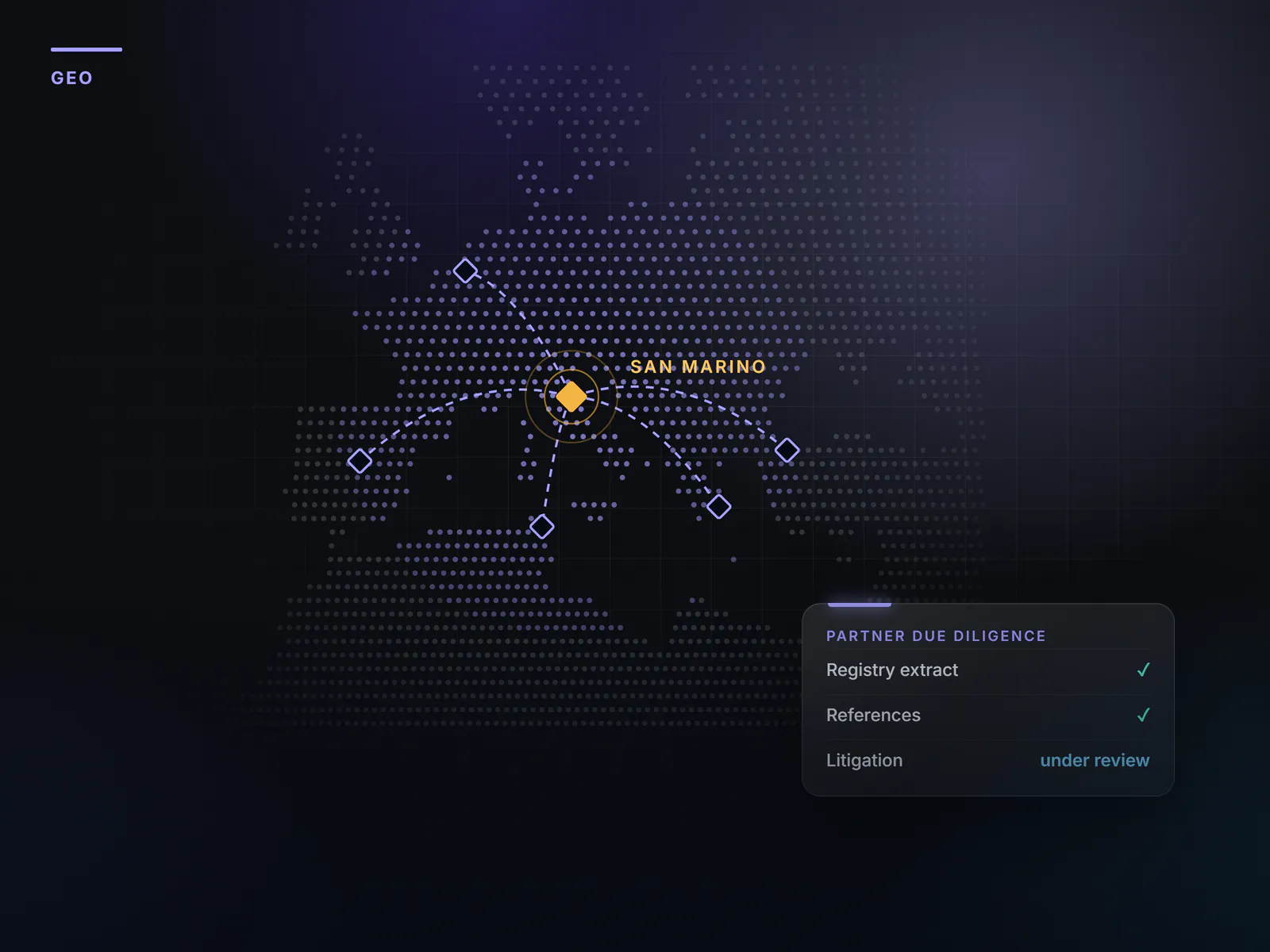
Example of the checks before entering a foreign market. The market and the parent company’s accounts are verified, while the counterparty and the trade mark still need clearing. In the background, a dotted map of Europe with San Marino linked to the destination country.

Business · Foreign markets

International expansion: check first, then go

We help companies decide where to expand abroad, with whom and how, check it all before signing, and take the first steps in good order. Many moves abroad stall on problems that could have been seen earlier, such as a distributor facing a lawsuit, a trade mark someone else has already registered or a parent company that cannot sustain two sites at once.

Before the contract
counterparty checks against registers, filed accounts and public sources
Numbers first
we test whether the parent company can carry the move before capital is committed
One point of contact
market, security, people and artificial intelligence at the same table

Example · the country, partner and data shown are not real

01 · copy the link to this sectionThe situation

‘If it works here, it will work abroad.’ That is the costliest mistake

Expanding abroad is a matter of risk before it is a matter of marketing.

International expansion means taking products, services or operations into other countries for the long term, with customers, partners and sometimes an office and staff on the ground. Not every country suits every business model. What works in Italy or San Marino may not work elsewhere, because prices, sales channels, rules and payment habits differ.

The cost is not only the money invested. It is also the months lost, the contracts to unwind and the company’s name tied to the wrong partner. The checks that prevent these mistakes never appear in a press release, and that is exactly why they get skipped. The time to do them is while changing course is still cheap. That means before you sign.

Typical scenario

A company opens an office abroad, hires a local manager and translates its website. Six months later it finds out that the distributor is in the middle of a lawsuit, that the IT supplier it chose does not follow local data rules, and that someone else has already registered its trade mark in that country. Nobody had checked.

Example comparison between the home market and the destination market for price, sales channel, product rules, trade mark and payment terms, with the items to check flagged.

02 · copy the link to this sectionHow we work

The checks, in the right order

There are six checks, from the market to the security of the new office. They come before any signature, not after.

The market

We look at real demand, competitors, prices, channels and sector rules. Two or three countries are compared on the same criteria.

The counterparty

We check company registers, filed accounts, sanctions lists, trade marks, news reports and references. You find out who you are tying yourself to before you commit.

The parent company’s finances

We work out how much capital and cash the move needs, for how long, and whether the company can sustain two sites at once.

The way in

You can enter through a partner, a distributor, a representative office or branch, or your own sales network. Each carries different commitments and risks, and the choice depends on the case at hand.

The people

We look at who will lead the market, at their skills and at references that can be checked. The handover with head office is put in writing.

Security at the new office

The new office brings new computers, suppliers and access rights. It needs the same protection as head office, from day one.

Engagement formats

FormatWhat it includes
Scoping conversationCountries, sector, project stage, next step
Scoped analysisOne market or one counterparty, with checks, risks and a written recommendation
Market entry projectThe six checks, the choice of entry route and support through the first steps, with written phases and deliverables
What the company receives
A report with the checks, the risks and the alternatives, plus a summary for the board with the recommendation and the next steps.
How we get to a proposal
After the first conversation you receive a written proposal with scope, timing, costs, and what is included and excluded. We do not publish prices.

03 · copy the link to this sectionEntry strategy

Four ways to enter a market

There is no single right way. There is the way that fits the product, the country and the company’s resources.

GEOLimited commitment Local partner It works for testing a market with little capital and for drawing on relationships the company does not have. The risk is depending on the choices of a single party. The clauses on exclusivity, targets and exit are what matter.
GEOCommercial distribution Distributor It suits standard products and volume. The risk is limited visibility of end customers and of the prices actually charged. Check who the distributor is, how it pays and what it already sells.
GEODirect presence Representative office or branch It makes sense when the market is strategic and customers want you close by. The risk lies in fixed costs, the country’s tax and employment rules, and a new site to protect. Decide early who runs it and with what powers.
GEOMarket control Own sales network It suits products that need advice and long relationships. The risk is the time it takes to build, and the people you must choose and train. What matters is the plan for the first months, with targets that can be checked.
Diagram of the four ways to enter a foreign market, from a local partner to your own sales network. The commitment required and the control over the market rise together.

04 · copy the link to this sectionArtificial intelligence

Artificial intelligence shortens the research. The decision stays with the company.

Before entering a country you have to read many documents in a language that is not your own, from laws and contracts to financial statements, press articles and tenders. This is where artificial intelligence really helps. It translates and summarises, compares clauses, and drafts a first map of competitors and prices from public sources. Every result is checked against the original source, and contracts remain a matter for lawyers.

Then there is the new office. What the export department knows (price lists, terms by country, certificates, shipping documents, answers already given to customers) usually sits in the heads of a few people. A Company Brain, the company’s own searchable memory, opens that knowledge to staff at the office abroad too. They see what their role allows, with the source next to every answer.

  • assisted reading of foreign-language laws and contracts, checked against the source
  • a first map of the market and competitors from public sources
  • the export department’s know-how available to the new office
  • assistants that answer foreign customers and make clear they are artificial intelligence
Example of a Company Brain for export. The office abroad asks which documents a shipment needs, and the answer cites the shipping procedure, the country sheet and the ERP price list, within the office’s permissions.

05 · copy the link to this sectionReference

San Marino, the European Union and the rules to check

Information checked at source, with the date. It does not replace your accountant or your lawyer.

Updated 16 September 2026

San Marino and the European Union

  • Customs union. San Marino is in a customs union with the European Union under the Agreement on Cooperation and Customs Union signed on 16 December 1991. For almost all goods, trade with EU countries carries no customs duties or quotas.
  • Association agreement. On 16 July 2026 the Council of the European Union authorised the signature and provisional application of the association agreement with Andorra and San Marino. The agreement provides for both countries to take part in the internal market under the same rules as the EU. For financial services, access will be phased in. As of 16 September 2026 the agreement has not yet been signed. The San Marino Government expects to sign it by October and to apply it provisionally from early 2027. After signature, the European Parliament must give its consent and the Council must conclude the agreement.
  • What this means for businesses can only be stated precisely once the text is in force. Until then, every choice (where to set up, how to invoice, where to keep data, how to hire) is assessed with the company’s own advisers. San Marino is not presented here as a tax shortcut. What counts is the substance of the business.

The rules to check before selling abroad

TopicWhat to checkWhere
International sanctionsWhether the country, the customer or the partner is subject to EU restrictive measuresEU Sanctions Map
Dual-use goodsWhether the product, including software or technology, needs an export authorisationRegulation (EU) 2021/821. In Italy, UAMA, the authorisation unit of the Ministry of Foreign Affairs
Duties, origin, requirementsCustoms duties, rules of origin and technical requirements in the destination countryEuropean Commission, Access2Markets
Trade markWhether the trade mark is available and registered in the countries where you sellEUIPO (EU trade mark), WIPO, Madrid System
Personal dataTransfers to countries outside the EU and the rules of the destination countryGDPR, Chapter V. In San Marino, Law No. 171/2018
Italian public supportSubsidised loans, loan backing, promotion abroadSIMEST (Fund 394/81), SACE, ICE Agency

This box is for information only and is not legal or tax advice. Measures and requirements change often, so check them at source when you take the decision. For businesses in San Marino the framework is different and must be assessed case by case.

Sources (consulted on 16 September 2026)

06 · copy the link to this sectionPrinciples

What we don’t do

  • We don’t promise ‘safe’ markets or sales results. We set out the risks and the alternatives. The decision stays with the company.
  • We don’t sell contacts or lists of distributors.
  • We don’t investigate individuals. Our checks rely on registers, financial statements, public lists and documents provided by the counterparty.
  • We don’t replace your accountant, your lawyer or your customs broker. We work with them.
  • We don’t design structures abroad whose purpose is to pay less tax.
The translated logo comes at the end, not at the beginning.

07 · copy the link to this sectionFrequently asked questions

Frequently asked questions about international expansion

Which country should we start with?
Start with the one where the product has demand you can demonstrate, the sales channels are accessible and the rules are manageable for the company. Proximity and language help, but they are not enough. Usually two or three countries are compared on the same criteria (demand, competition, prices, regulation, entry costs). You then start with one, with targets and review dates set down in writing.
Do we need an office, or is a distributor enough?
It depends on the product and on how much control the company wants over the market. A distributor needs less capital but gives little visibility of end customers. An office brings presence and control, but also fixed costs, the country’s tax and employment obligations, and an organisation to run and protect. Companies often start with a partner and open an office when the numbers justify it.
How do you check a foreign partner?
The starting point is the country’s company registers, filed accounts, international sanctions lists and registered trade marks. News reports, references and the documents the partner itself provides come next. The contract then sets out targets, exclusivity and exit terms. Investigations into individuals, which in Italy require a licence, are not part of our work.
Is there funding for international expansion?
For Italian companies, yes. SIMEST manages the subsidised loans of Fund 394/81 together with the Ministry of Foreign Affairs. SACE backs bank financing and insures export credit. ICE Agency supports promotion abroad. Conditions, requirements and application windows change over time, so check them on the official websites when you apply. For businesses in San Marino the framework is different and must be assessed case by case.
How long do the checks take?
It depends on how many countries and counterparties are involved, how many documents are available and how quickly foreign registers respond. After the scoping conversation you receive a written proposal with the phases, timing and costs, and what is and is not included. Progress is reviewed at agreed dates.
Can artificial intelligence do market research?
It can make it faster. It reads and summarises documents in other languages, compares competitors and the prices they publish, and drafts a first map of the market. It does not replace real sales data, conversations with potential customers or checks against the original sources. That is why a person verifies every result produced with AI before it goes into a document for the board.

08 · copy the link to this sectionObservatory

From the Observatory: foreign markets

Guides from the Strategic editorial team on offices abroad, partners and dependence on a single country.

All articles on foreign markets

The essential parts of this page print as a short summary of a few pages, without images or invitations to get in touch.

09 · copy the link to this sectionContact

A country in mind? Let’s talk before you sign

A few lines are enough. Tell us which countries you are considering and why, your sector, and how far the project has got. We reply by email, usually within two working days.

Please don’t put contracts or confidential counterparty data in the form. They are exchanged once a non-disclosure agreement (NDA) is in place.

On WhatsApp, messages are answered by Strategic’s AI assistant. Please do not use it for confidential information.

Your requestGEOForeign markets

Do any of these questions sound familiar? tick the ones that apply to you

The form opens with the topic and the questions already filled in.