AI transparency · updated 16 September 2026
How we use artificial intelligence, and what stays in human hands
We help companies use artificial intelligence, and we use it ourselves. Here we explain where, under what rules, and what stays in human hands. Anyone who writes to us should know who they are talking to. Anyone who works with us should know what happens to their documents.

- AI disclosed
- every assistant introduces itself as AI
- A person decides
- no choice about clients, candidates or employees is left to a system
- No invented people
- no generated faces, voices or scenes on the site
01 · copy the link to this sectionIn brief
Why this page
Anyone who brings artificial intelligence into companies should be the first to explain how they use it. The rules point the same way. In Europe, anyone who offers a system that converses with people must make that known. In Italy, anyone practising one of the ‘intellectual professions’ must tell clients which AI tools they use. We prefer to say it plainly, before anyone asks.
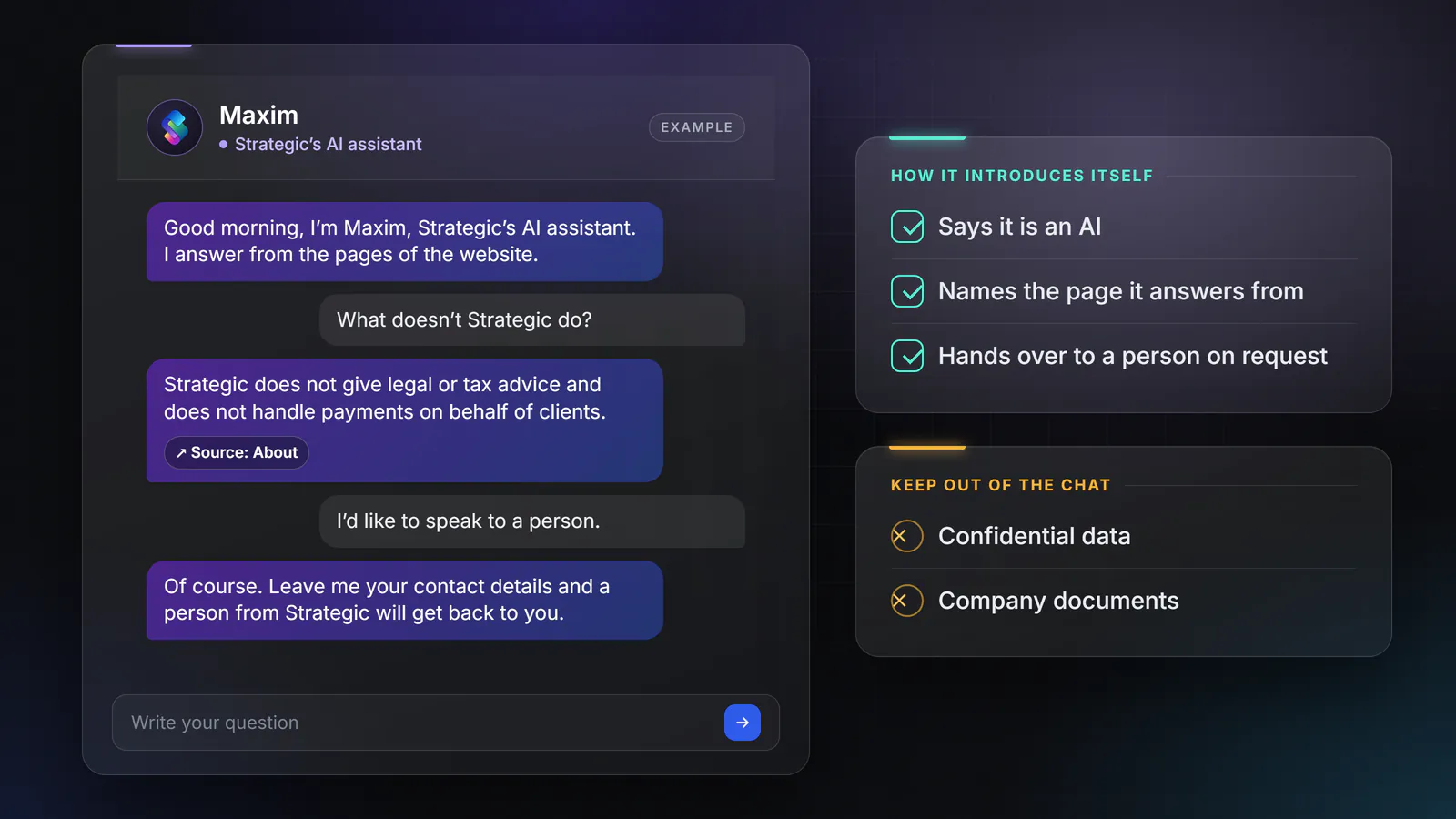
Disclosed assistants. On WhatsApp an AI assistant answers, and says so. The same applies to the site chat.
Articles. They may be produced with the help of AI. They are published under the responsibility of the Strategic editorial team.
Illustrations. They are drawn graphics. No people are generated.
Client work. AI helps with the preparation. People check, decide and are accountable.
02 · copy the link to this sectionOn the site
Where you will find it on this site
There are five places, and for each one we say how it is disclosed.
03 · copy the link to this sectionThe rules
In client work: the rules we set ourselves
Artificial intelligence helps us read documents, prepare drafts, write code and translate. It does not change who is accountable for the work.
- We say so first, then we use it. In the proposal we state whether and where we will use artificial intelligence tools. If you would rather they were not used on your work, we put that in writing and allow for it in the timeline.
- Your documents stay under control. Which tools may read an organisation’s documents, where the data resides and whether the vendor may use it to train its models are all decided with the organisation before work begins, and put in writing.
- A person checks. Every document, analysis or line of code we deliver is checked by a member of the project team, who is accountable for it.
- Decisions stay with people. No assessment of clients, candidates or employees is left to an automated system. AI prepares the material. A person decides.
- Blackroom stays out of it. We do not use artificial intelligence tools on owners’ confidential matters.
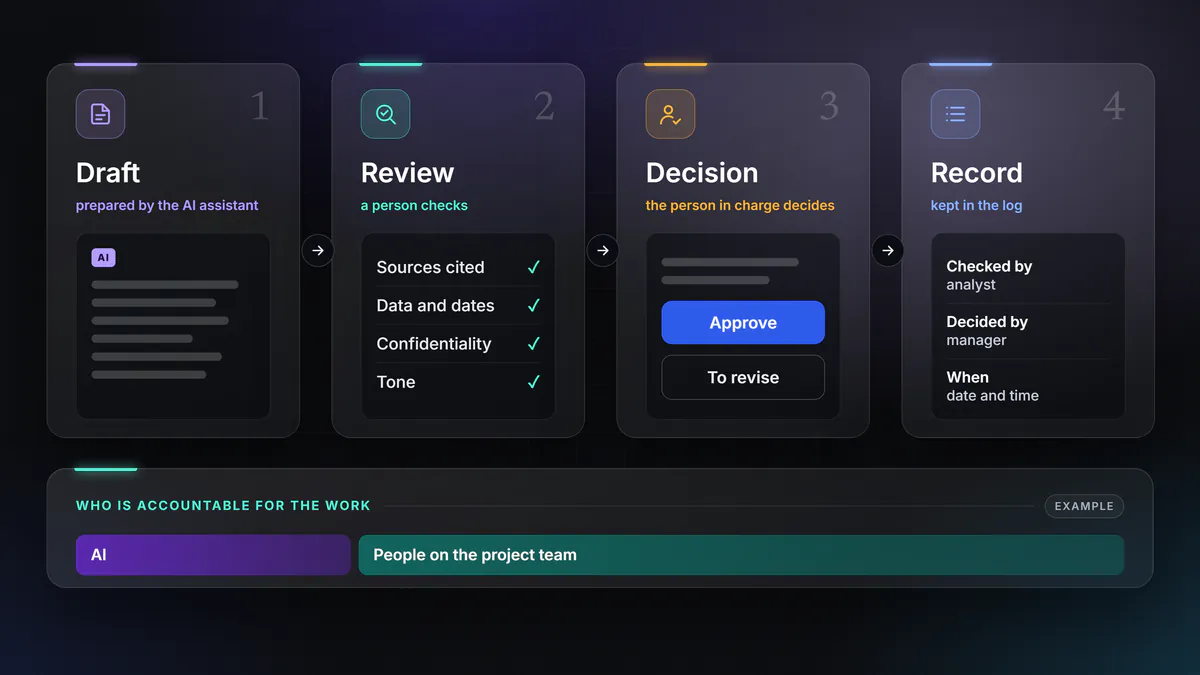
The path of every deliverable
04 · copy the link to this sectionThe data
Where the data goes
Chat conversations. They are used to answer you and, if you ask, to get back to you. They are kept for the period stated in the privacy policy. The text of your questions is passed to the provider of the language model that generates the answers, OpenAI, within the limits described in the privacy policy.
WhatsApp messages. They pass through WhatsApp, through the servers of the services that handle the replies and through the providers of the language models used for the replies. These providers are listed in the service documentation, and you can ask for the current list through the contact form.
No profiles of the people who write to us. Conversations are not used to build advertising profiles, and they are not sold or passed on to others for their own purposes.
Your rights. You can ask to access, correct or delete your data. The privacy policy explains how.
05 · copy the link to this sectionReference
The rules that apply
Updated 16 September 2026
| Law | What it requires, in brief | How we apply it |
|---|---|---|
| AI Act, Regulation (EU) 2024/1689, Article 50(1), in the European Union, from 2 August 2026 | AI systems intended to interact directly with people must be designed so that the people using them know they are dealing with an AI system | The chat and the WhatsApp assistant introduce themselves as AI |
| AI Act, Article 50(4) | Anyone who publishes AI-generated text to inform the public on matters of public interest must disclose it, unless the text has undergone human review or editorial control and someone holds editorial responsibility for it. The same article requires disclosure of images, audio and video that realistically imitate people or events | Articles are published under the responsibility of the Strategic editorial team. No image imitates real people or events |
| Law No. 132 of 23 September 2025 (Italy’s AI law), Article 13, in Italy | In the intellectual professions, AI is only a support tool and intellectual work must remain predominant. Information on the AI systems used is given to the client in clear, simple and comprehensive language | In our proposals we state which AI tools we will use |
| GDPR, Regulation (EU) 2016/679, Article 22 | The right not to be subject to decisions based solely on automated processing that produce legal effects or similarly significant effects | No decision about people is taken by an automated system |
| Law No. 171 of 21 December 2018, in San Marino | Protection of individuals with regard to the processing of personal data | The processing carried out on the site is described in the privacy policy |
This is general information and does not constitute legal advice.
Sources (consulted on 16 September 2026)
- Regulation (EU) 2024/1689, EUR-Lex
- Regulation (EU) 2026/1744 of 8 July 2026 (Digital Omnibus on AI: Article 50 still applies from 2 August 2026), EUR-Lex
- European Commission, Transparency obligations under Article 50 of the AI Act, FAQ of 24 July 2026
- Law No. 132 of 23 September 2025, Article 13, Normattiva (in Italian)
- Regulation (EU) 2016/679, EUR-Lex
- Consiglio Grande e Generale (San Marino’s parliament), Law No. 171 of 21 December 2018 (in Italian)
06 · copy the link to this sectionPrinciples
What we don’t do with artificial intelligence
- We don’t pass off an AI assistant as a person.
- We don’t generate faces, voices or people for the site or for our communications.
- We don’t leave it to a system to decide about clients, candidates or employees.
- We don’t put client documents into tools that have not been agreed.
- We don’t use AI assistants in Blackroom.
Artificial intelligence prepares. People decide, and they are accountable.
07 · copy the link to this sectionFor businesses
The same rules, on your systems
 AI
AI security and governance
Usage rules, a register of systems and testing of the assistants that read company data.
 AI
AI training
People who use the tools learn to read an answer and check its source.
 AI
Company Brain
An assistant on the company’s own documents that shows where each answer comes from.
08 · copy the link to this sectionFrequently asked questions
Frequently asked questions about how we use artificial intelligence
Am I talking to a person or to an AI?
What happens to what I write in the chat?
Are the articles written by artificial intelligence?
Are the images generated with artificial intelligence?
Do you use artificial intelligence on our company’s documents?
Can we ask you not to use it on work that concerns us?
Who updates this page?
09 · copy the link to this sectionContact
A question about how we use artificial intelligence?
Write to us through the contact form. For requests about your personal data, the privacy policy explains what to do. We reply within two working days.