San Marino and the European Union: what the association agreement changes for businesses
The association agreement will bring San Marino into the EU internal market, with the same rules and the same conditions of competition. It is not yet in force. Where it stands, what will change for businesses and what to prepare.
The association agreement between the European Union and San Marino will bring the Republic into the EU internal market, with free movement of goods, people, services and capital, under the same rules and the same conditions of competition as the member states. It will replace the customs union in force since 2002, which covers goods only. For San Marino businesses it means a bigger market and more EU rules to apply. For Italian and other European businesses it means access to San Marino without discrimination on grounds of nationality. But the agreement is not yet in force. The Council of the European Union authorised its signature and provisional application on 16 July 2026. Signature is expected between late September and mid-October, and the San Marino government points to 2027 for the start of provisional application. There is time to prepare, and now is the moment to use it.
Status of the agreement checked on 16 September 2026 against the sources listed at the end.
Where does the agreement stand?
| When | What |
|---|---|
| December 2014 | The Council of the European Union authorises negotiations with Andorra, Monaco and San Marino |
| March 2015 | Negotiations formally open |
| September 2023 | Monaco and the Commission suspend negotiations. Andorra and San Marino continue |
| December 2023 | Negotiations conclude |
| 26 April 2024 | The European Commission presents its proposals for decisions on signature, provisional application and conclusion |
| 16 July 2026 | The Council authorises signature and provisional application |
| Late September to mid-October 2026 | Signature expected, after pre-signature by the member states |
| October to December 2026 | Scheduled examination by the Foreign Affairs Committee and by the Great and General Council (Consiglio Grande e Generale), San Marino’s parliament |
| 2027 | Expected start of provisional application |
After signature, the Council will seek the European Parliament’s consent before formal conclusion. It is a mixed agreement, which the individual member states also sign. Full entry into force will follow ratification, and in the meantime the agreement can be applied provisionally.
At the Foreign Affairs Committee on 10 September 2026, San Marino’s Secretary of State for Foreign Affairs reported that provisional application will start on the first day of the month after San Marino notifies its ratification. Some parts will be excluded, including cooperation on tax matters. The target is 1 January 2027, if every step goes smoothly. In San Marino’s political debate, the idea of a referendum after signature has also been put forward.
What changes in substance?
Today, economic relations rest on the agreement on cooperation and customs union signed in 1991 and in force since April 2002, which covers all goods. The association agreement goes further. The European Commission describes it as participation in an extended, homogeneous internal market, with a level playing field and the same rules. A briefing paper from the Italian Chamber of Deputies compares it, in terms of market access, to the arrangements that Norway, Iceland and Liechtenstein have through the European Economic Area.
These are the elements that affect businesses:
- The four freedoms. Goods, people, services and capital move under internal market rules, with a ban on discrimination on grounds of nationality.
- EU rules. San Marino adopts the EU legislation listed in 25 annexes. They cover food safety, technical rules and product certification, liability for defective products, energy, free movement of workers and social security, professional qualifications, establishment, services, competition, state aid, public procurement, intellectual property, employment and health and safety at work, consumer protection, the environment, company law and customs. The alignment is dynamic, so new EU rules are incorporated over time.
- Oversight. The European Commission is the authority that applies the state aid rules in San Marino, and the Court of Justice of the European Union rules on disputes over the interpretation of the agreement.
- Adjustments. Because of the country’s size, the agreement provides for adjustments. These include quantitative limits on some types of residence, modelled on those agreed with Liechtenstein, and transitional periods in sectors such as telecommunications, transport and energy.
- Financial services. Access to the EU market is gradual. It comes after an assessment of how sound San Marino’s rules and supervision are, with a central role for the European supervisory authorities. Compliance with anti-money laundering rules is a precondition. San Marino may choose not to request full access straight away, for no more than fifteen years from entry into force.
What stays the same?
San Marino does not join the European Union. Association is a different relationship from membership. The 2012 monetary agreement, which governs the use of the euro, remains in force. So does the 2004 agreement, amended in 2015, which today covers the automatic exchange of financial account information. Until application begins, today’s rules continue to apply, including those on customs, invoicing and tax in trade with Italy.
What does it mean for San Marino businesses?
It brings more opportunities and more obligations. On the opportunity side, companies will be able to offer services and open offices in the EU under internal market rules, bid for public contracts as provided for in the procurement annex and have their professional qualifications recognised. On the obligation side, businesses that today work only within the Republic may have to apply EU rules that have not concerned them until now, on products, consumers, competition, the environment and employment.
The government has said that several bills to bring domestic law into line should be ready shortly, and the political debate on how to transpose EU rules is still open. Following those texts, sector by sector, is the first useful thing to do.
And for Italian and other European businesses?
For those who work with San Marino, the agreement extends to the Republic the ban on discrimination by nationality and the internal market rules on establishment, services, procurement and qualifications. Anyone with long-term contracts with San Marino counterparties would do well to reread the clauses on regulatory change. Anyone considering San Marino as a base or as a market should know the transitional periods for their sector before deciding.
What should you do now?
- Map your products and regulated activities and find the EU rules that apply to them in the annexes.
- Measure the gap between the rules you follow today and the EU ones. Many businesses that sell in Italy already apply some of them.
- Follow San Marino’s transposition laws and the transitional periods for your sector. In the text the Commission proposed in 2024, references to entry into force apply from the date of provisional application. That is when the clock starts.
- Review long-term contracts and authorisations.
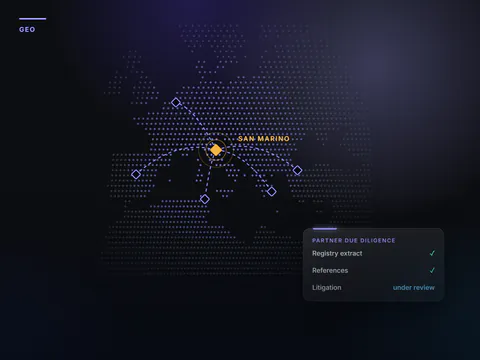
- Rethink your markets. Consider which EU countries become reachable with your services, with which partners and with what checks. Before opening an office across the border, carry out the due diligence described by the Observatory.
- Think about people, from worker mobility to expertise in EU rules.
What is still unknown?
- The date of signature and the start date of provisional application.
- The text of San Marino’s transposition laws.
- The outcome of the political debate, including the possibility of a referendum.
- The details of the signed text, which will need to be read sector by sector once it is published.
In brief
- The agreement will bring San Marino into the EU internal market, with the same rules and conditions of competition, replacing the customs union.
- The Council of the EU authorised its signature and provisional application on 16 July 2026. Signature is expected between late September and mid-October 2026.
- The San Marino government points to 2027 for the start of provisional application, with some parts excluded.
- San Marino businesses will gain a bigger market and more EU rules to apply. For financial services, access is gradual.
- San Marino stays outside the EU, and the monetary agreement on the euro remains in force.
Frequently asked questions
Is San Marino joining the European Union?
No. The association agreement brings San Marino into the internal market under the same rules, but the Republic stays outside the European Union.
When will the agreement apply?
It will apply after signature and ratification by San Marino. The Republic’s government points to 2027 for the start of provisional application, with 1 January as the target if every step goes smoothly. Transitional periods are then planned for a number of rules.
Does anything change for the euro?
No. The 2012 monetary agreement between the European Union and San Marino remains in force after the association agreement too.
Will San Marino banks be able to operate across the EU straight away?
No. Access for financial services is gradual and depends on a positive assessment of San Marino’s rules and supervision, with compliance with anti-money laundering rules as a precondition.
Understanding which markets are opening up, under which rules and with which partners, is the work of Strategic’s International expansion division. It supports companies all the way from choosing the market to vetting partners and setting up the new office.
Sources
Consulted on 16 September 2026.
- Council of the European Union, Council greenlights EU deal with Andorra and San Marino, press release of 16 July 2026
- European Commission, proposal for a Council decision COM(2024) 189 on the conclusion of the association agreement, explanatory memorandum and text, EUR-Lex
- Italian Chamber of Deputies, EU Relations Office, briefing paper no. 80 of 10 December 2024 on the proposals for the association agreement (in Italian)
- Secretariat of State for Foreign Affairs of the Republic of San Marino, The process of association with the European Union
- Italian Ministry of Foreign Affairs and International Cooperation, press release of 16 July 2026 on the EU–San Marino association agreement
- Tribuna Politica, report on the meeting of the Great and General Council’s Foreign Affairs Committee of 10 September 2026 (in Italian)
- Agreement on cooperation and customs union between the European Economic Community and the Republic of San Marino, EUR-Lex
 Find out moreInternational expansionChoosing markets, vetting foreign partners, security and people for the new office, and a plan so that you do not depend on a single country.