Chief Restructuring Officer: when the CFO knows the company too well to save it
Whoever wrote and defended the plan finds it hard to admit that it no longer holds up. Here is what an external Chief Restructuring Officer does, which signs make one necessary and how to set up the engagement.
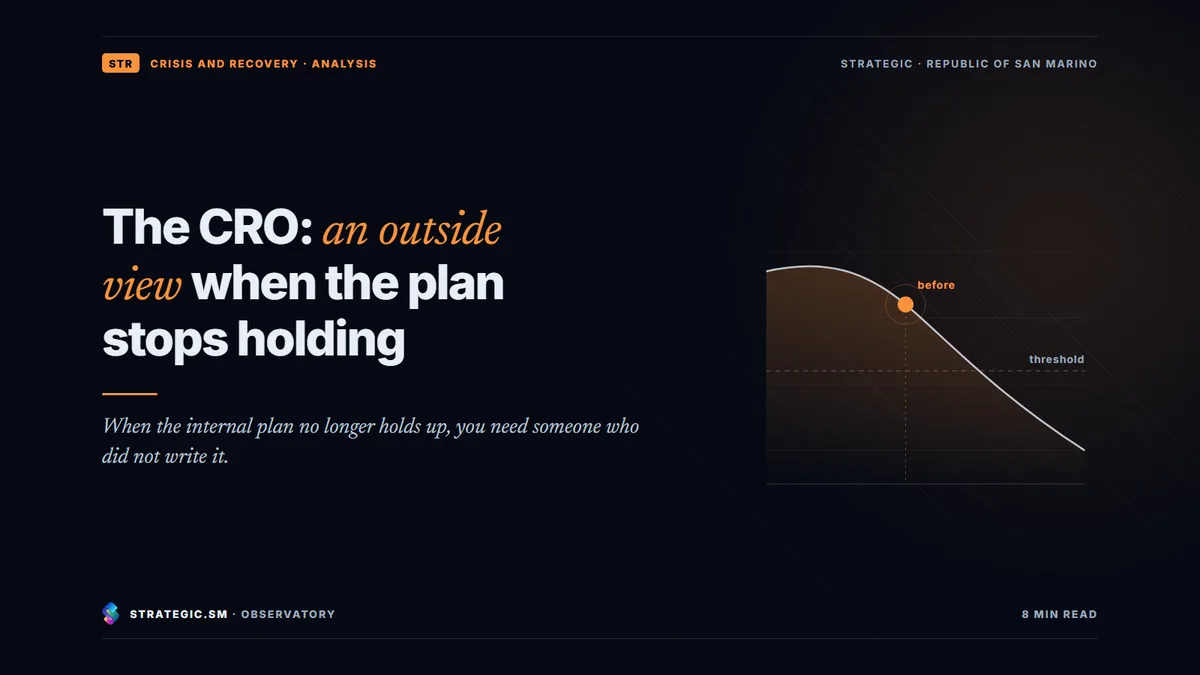
A Chief Restructuring Officer (CRO) is the manager, almost always from outside the company, whom the board of directors puts in charge of a recovery when the current plan no longer holds up. A CRO is needed when the warning signs pile up and the people who built that plan, starting with the chief financial officer, find it hard to call it into question. The CRO does not take the CFO’s place. The two work side by side, under a written mandate, on cash, debt and negotiations with banks and suppliers.
A typical scenario. The board meets and the CFO presents the quarter’s figures, “in line with revised expectations”. It is the third quarter in a row. Meanwhile the bank has asked for a waiver of the covenants, the conditions the loan agreement requires the company to meet. Two strategic suppliers want to be paid in advance, and around the table people keep saying that the market is picking up. Nobody wants to be the first to say the plan is not working. Admitting it would mean admitting that they wrote it, approved it and defended it for months.
What is a Chief Restructuring Officer?
The Chief Restructuring Officer is the person who leads a company under financial strain from the diagnosis through to carrying out the recovery plan. Italian law does not regulate the CRO as a role in its own right. Powers and responsibilities depend on the mandate given by the company’s governing body. The CRO can be a director with delegated powers, an interim manager with a power of attorney, or an adviser who supports the board without signing powers.
It is worth distinguishing the CRO from other figures who often appear in a crisis:
| Role | Appointed by | What they do | What they do not do |
|---|---|---|---|
| Chief Restructuring Officer | The board of directors | Leads the recovery within the limits of the mandate, covering cash, costs and negotiations | Does not certify the plan and does not replace the lawyers |
| Financial adviser | The company | Prepares analyses, the plan and documents for the banks | Usually has no management powers |
| Certifier (attestatore) | The company, from among independent professionals | Checks that the data is true and the plan is feasible | Cannot have worked for the company in the previous five years |
| Expert in the negotiated crisis settlement (composizione negoziata) | A committee set up at the Chamber of Commerce | Facilitates negotiations with creditors | Does not run the company, which stays in the owner’s hands |
Why is the internal CFO no longer enough on their own?
It is not a question of competence. The finance director who built the business plan, negotiated the credit lines and defended the figures before the board for years has a problem of position. They are part of the story that led to the problem. Every correction they propose starts, often without their realising it, from the idea that the original plan was right and that a course correction will do.
Then there is the problem of time. The CFO still has to close the accounts, prepare the reports and answer the banks and the auditors. A recovery is a second full-time job, run at a weekly pace.
Someone from outside has no version of events to defend and no relationships to protect with the rest of management. They look at the cash, the contracts and the deadlines, and they can say to everyone, with the same frankness, what is hard to say from the inside.
What does the CRO do in the first weeks?
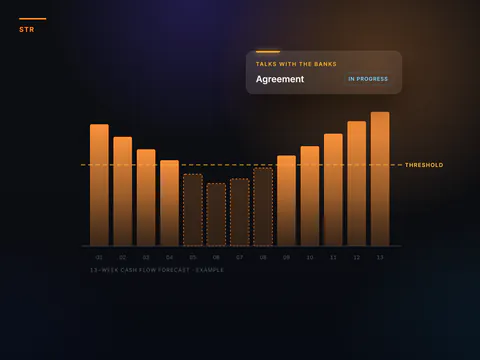
The first job is not strategic. It is rebuilding the real cash position, not the budgeted one. Restructuring practice relies on a week-by-week forecast covering the next three months (the 13-week cash flow forecast), with every critical supplier and every bank deadline included. That forecast shows how much time is really left before the company can no longer pay salaries and suppliers.
On that basis, and within the limits of the mandate, the CRO:
- Lines up the debts by creditor and by due date, and reads the loan agreements to find out which conditions are already at risk.
- Prepares and leads the negotiations with banks, leasing companies and suppliers, who are often more willing to listen to a new face.
- Separates what generates cash from what only generates revenue, with margins by product and by customer.
- Assesses, with the company’s lawyers and accountant, which tool of the Italian Business Crisis Code (Codice della crisi d’impresa e dell’insolvenza) to use. The options are the negotiated crisis settlement, the certified recovery plan (piano attestato di risanamento), debt restructuring agreements, the standstill agreement (convenzione di moratoria) or, if creditor consent is not enough, a composition with creditors (concordato preventivo).
- Reports to the board regularly, using a few indicators agreed at the outset.
The simplified composition with creditors (concordato semplificato) is not a way to relaunch the company. It is used to liquidate its assets.
Which signs show that an outside figure is needed?
Some indicators, when they appear together, make it clear that a third-party view is needed:
- The average number of days it takes to collect from customers has been growing for several quarters, and nobody can point to a market reason.
- Short-term credit lines are used to the limit all the time, not just in the seasonal months.
- A key supplier asks for payment in advance or shortens its payment terms.
- The bank asks for information outside its usual schedule, or for new collateral when the credit facility is renewed.
- The budget is revised several times in the same year.
- Key people in finance and administration leave the company without convincing explanations.
Taken one by one, they all have a plausible explanation. Together they tell a different story. Article 2086 of the Italian Civil Code requires those who run a company to put in place arrangements that are adequate to detect a crisis in time, and to act without delay when they see one. Waiting for the definitive signal is not a neutral choice.
How much does waiting cost?
Every week lost narrows the options. A deal with the banks sought with two months of headroom is a different negotiation from the same deal attempted a few days before an instalment that cannot be paid. Suppliers who would accept a repayment plan today might, a month from now, ask for security that the company can no longer provide.
The legal tools need time too. The negotiated crisis settlement, for example, can be requested when a recovery is still reasonably possible. The more the situation deteriorates, the harder that is to show. In a recovery, time is the resource that runs out fastest.
How do you set up the engagement?
A CRO engagement works when a few things are clear from the first day:
- A written mandate from the board of directors, setting out scope, powers, duration and reporting lines.
- Full access to the data, meaning the ERP system, bank statements, contracts and payment schedules.
- Separate roles: the CRO cannot also certify the plan, and works with the accountant, lawyers, auditor and board of statutory auditors (collegio sindacale) without replacing them.
- Agreed indicators, checked regularly, and a criterion for deciding when the engagement is complete.
Where the systems allow it, artificial intelligence takes hours out of the most repetitive work. It reads bank statements and payment schedules to update the cash forecast, extracts the terms of loan agreements and puts them in a table, and keeps an archive of decisions that can be searched with a simple question, as in a Company Brain, the company’s own searchable memory. Checks and choices stay with people, and when the data belongs to a company in difficulty, confidentiality comes first.
And in San Marino? The Business Crisis Code is Italian law. For companies based in San Marino, the framework must be assessed case by case.
In brief
- The Chief Restructuring Officer leads the recovery alongside the CFO, with the powers granted by the board of directors.
- A CRO is needed when the warning signs pile up and whoever wrote the plan struggles to correct it.
- The first job is the real cash position, week by week. Debts, contracts and negotiations come next.
- The Business Crisis Code tool is chosen with the lawyers and the accountant. The simplified composition is a liquidation tool, not a relaunch.
- Waiting for the definitive signal closes off the lighter options.
Frequently asked questions
What is the difference between a CRO and a financial adviser?
The adviser prepares analyses, the plan and documents, and usually has no management powers. The CRO, by contrast, leads the execution of the recovery within the limits of the mandate received from the board of directors. If the mandate allows it, the CRO can lead negotiations, decide on payments or reorganise costs.
Who appoints the Chief Restructuring Officer?
The company’s governing body chooses the CRO. That means the board of directors or the sole director, who sets out the CRO’s powers, term and reporting duties in writing. Sometimes the banks ask the company to bring in a CRO as a condition for negotiating, but the appointment remains the company’s decision.
How long does the engagement last?
There is no standard duration. It depends on the situation and on the tool chosen. The engagement usually covers the diagnosis, the negotiations with creditors and at least the first part of carrying out the plan. It helps to agree from the start on the criterion for considering it complete.
Can the CRO also certify the plan?
No. The certifier must be an independent professional who meets the requirements set by Article 2 of the Business Crisis Code. Among other things, they must not have worked for the company in the previous five years, nor have ties that could compromise their judgement. Whoever leads the recovery therefore cannot certify its plan.
When the internal plan no longer holds up and you need an independent diagnosis, our page on restructuring and turnaround explains how we work alongside management, with the company’s lawyers and accountants, from the snapshot of the accounts through to carrying out the plan.
Sources
Consulted on 16 September 2026.
- Legislative Decree 14 of 12 January 2019, Italian Business Crisis Code (Codice della crisi d’impresa e dell’insolvenza), Normattiva, Articles 2, 12-25-undecies, 25-sexies, 56, 57, 62 and 84 (in Italian)
- Italian Civil Code, Article 2086, Normattiva (in Italian)
- National online platform for the negotiated crisis settlement, Italian Chambers of Commerce (in Italian)
 Find out moreRestructuring and turnaroundDiagnosis, short-term cash, a plan and the relationship with the banks for companies under strain or in transition, working alongside the company’s lawyers.