
Business · Foreign markets · Business continuity
Beyond a single country: a plan to keep working even if a border closes
We map where your company depends on a single country and, with your tax and legal advisers, prepare an alternative that is ready and compliant. In many companies the bank account, the contracts, invoicing, access to systems and the people who sign all run through one country. That works, until it doesn’t.
- The map comes first
- where the company would really stop, point by point
- Compliant in every country
- every choice validated with your tax and legal advisers
- Advice only
- we don’t collect payments, make payments or manage accounts
Example · the company and the values shown are not real
01 · copy the link to this sectionThe situation
When stability becomes an assumption
People think of IT failures. But a country can also bring a company to a halt.
Business continuity is a company’s ability to keep serving its customers when something important stops working. The issue here is not where the company is based. It is the operational paralysis that sets in when everything depends on one place.
A few examples, without alarmism:
- a bank suspends an account for checks, even when the business is entirely legitimate
- new sanctions or restrictions hit a supplier or a customer
- a cloud service changes its terms or pulls out of a market
- the only person who can sign is stuck in another country
- a port, a customs office or a transport link is closed for weeks
When it happens, the question is always the same. What do we do on Monday morning? Those who have prepared the answer know where to start. Those who have not must build it under pressure, while salaries, suppliers and customers wait.
02 · copy the link to this sectionWhere to look
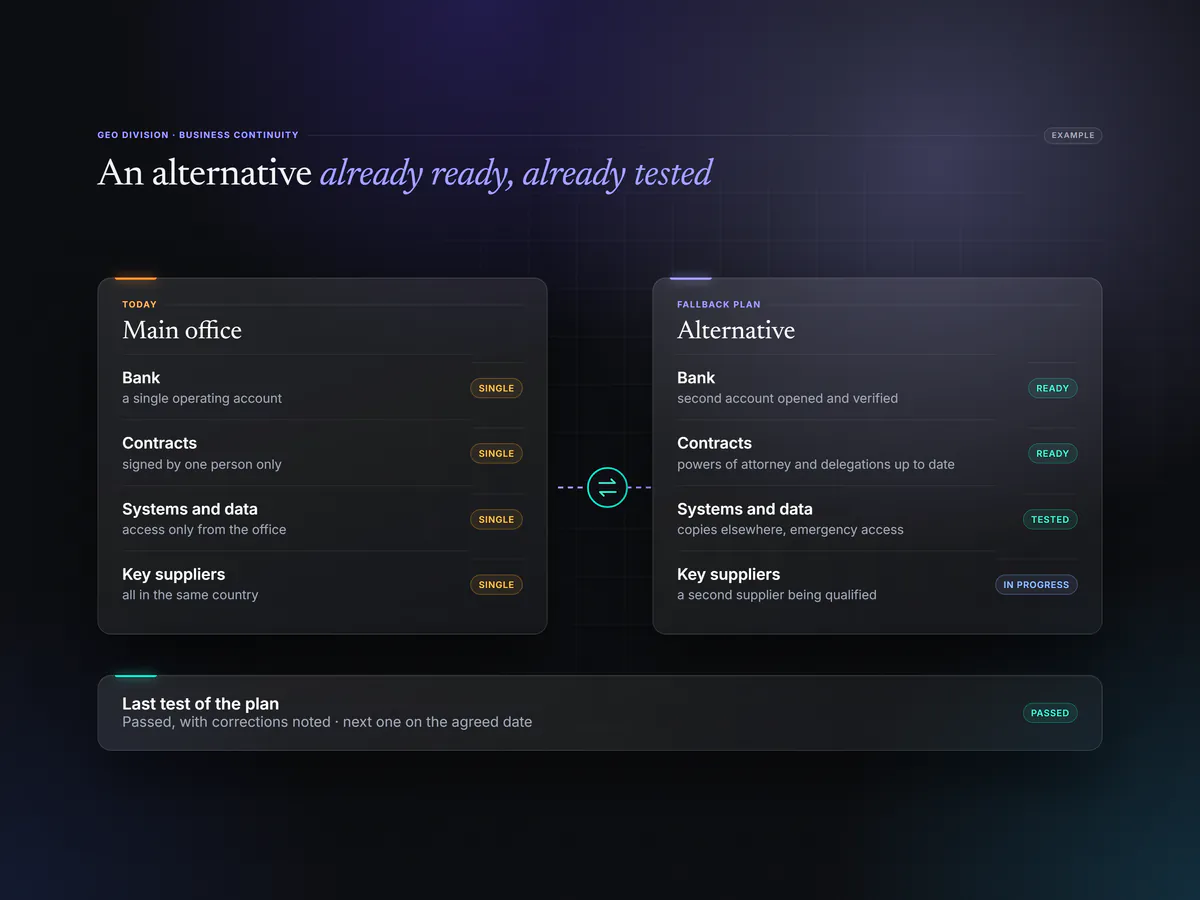
Six points where a company can come to a halt
For each point there is only one question. If the country you depend on came to a halt, could the company do this somewhere else and stay compliant?
03 · copy the link to this sectionHow we work
From the map to the test
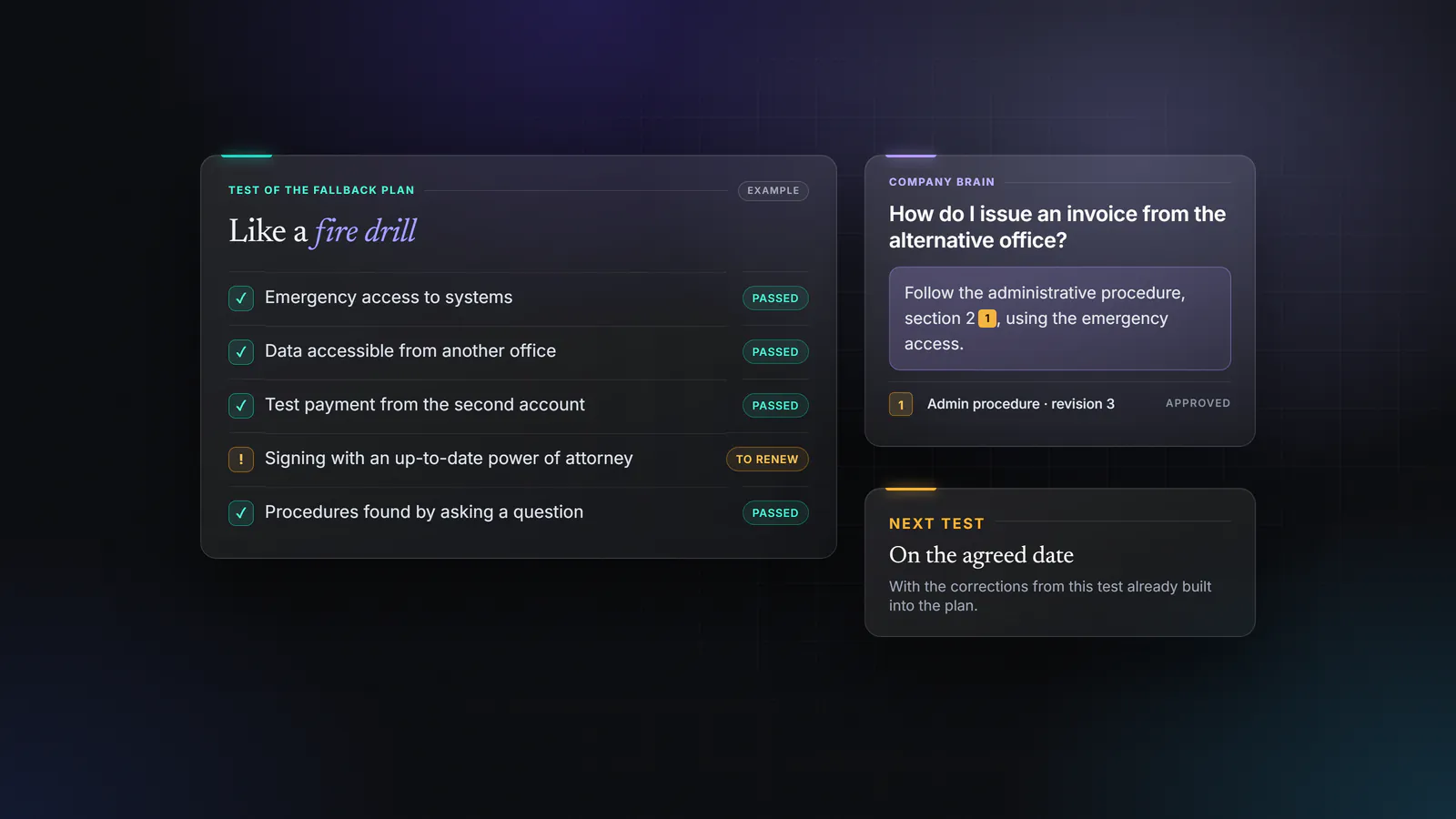
There are four steps. The last one is repeated at agreed intervals, like a fire drill.
Confidential dependency map
We map banks, customers, suppliers, systems, people and obligations, each with its degree of concentration. The work is covered by a non-disclosure agreement (NDA).
Fallback plan
For each critical dependency we set out a realistic alternative, covering who, where, at what cost and under which rules.
Putting it in place with your advisers
The choices are put into practice with tax and legal advisers in the right country, either the company’s own or ones we find together.
Regular testing
It works like a fire drill. At agreed intervals we check that the alternative really works, and we update the plan.
Engagement formats
| Format | What it includes |
|---|---|
| Confidential conversation | Situation, countries involved, next step |
| Dependency map | The six points analysed, degree of concentration, priorities, summary for management |
| Fallback plan | Alternatives for critical dependencies, people responsible, test schedule |
| Periodic review | Testing and updating the plan at agreed intervals |
- What the company receives
- The dependency map, the fallback plan with the people responsible for each part, the list of tests to repeat and a summary for management.
- Timing
- Lead times that depend on third parties, such as opening an account or qualifying a supplier, cannot be promised. The written proposal keeps them separate from the ones that depend on us.
Every format starts from a written proposal. We do not publish prices.
04 · copy the link to this sectionArtificial intelligence
An alternative only works if the know-how travels
A fallback plan often stalls on a simple question. How do we actually do this? The procedures for invoicing, paying, shipping and answering a customer live in the heads of a few people, in a single office. If that office stops, the know-how stops with it.
A Company Brain, the company’s own searchable memory, makes those procedures available to the people entitled to see them, even from another site. You ask questions in plain language. Answers come with their source and date, and permissions follow each role. Artificial intelligence also helps write the procedures, starting from documents, emails and interviews with key people. A person always approves the final text.
The know-how another site needs
05 · copy the link to this sectionReference
The rules to follow
An alternative abroad is only useful if it is compliant. Here are four references to know before you decide.
Updated 16 September 2026
| Topic | What it provides | Reference |
|---|---|---|
| Tax residence of companies | A company is resident in Italy if, for most of the tax period, its registered office, its place of effective management or its main day-to-day management is in Italy. A foreign structure without real decisions and real activity does not change where the company is resident. | TUIR, Italy’s Consolidated Income Tax Act (Presidential Decree 917/1986), Article 73(3), as amended by Legislative Decree 209/2023 |
| Anti-money laundering | Banks and professionals must know the customer and the source of the funds. If they cannot carry out these checks, they must refrain from the transaction or the relationship. | Italy: Legislative Decree 231/2007 (the anti-money laundering law), Article 42 · San Marino: Law No. 92 of 17 June 2008 |
| Continuity in companies subject to NIS2 | The mandatory measures include business continuity, backup management, disaster recovery and crisis management. | Legislative Decree 138/2024 (Italy’s NIS2 law), Article 24(2)(c) · Cybersecurity |
| Switching cloud provider | Since 12 September 2025, contracts must allow switching to another provider. From 12 January 2027, providers can no longer charge for the switch. | Regulation (EU) 2023/2854 (Data Act), Chapter VI |
This box is for information only and is not legal or tax advice. For businesses in San Marino the framework is different and must be assessed case by case.
Sources (consulted on 16 September 2026)
- Presidential Decree No. 917 of 22 December 1986 (TUIR), Article 73, Normattiva (in Italian)
- Italian Revenue Agency (Agenzia delle Entrate), Circular No. 20 of 4 November 2024 on tax residence (in Italian)
- Legislative Decree No. 231 of 21 November 2007, Normattiva, Article 42 (in Italian)
- San Marino Financial Intelligence Agency (AIF), legislation in force, including Law No. 92 of 17 June 2008 (in Italian)
- Legislative Decree No. 138 of 4 September 2024, Normattiva, Article 24 (in Italian)
- Regulation (EU) 2023/2854 (Data Act), EUR-Lex, Articles 23–31
06 · copy the link to this sectionPrinciples
What we don’t do
- We don’t collect payments, make payments or manage accounts on behalf of clients.
- We don’t set up companies, and we don’t provide registered addresses or nominee directors. Structures are put in place with licensed professionals in the country concerned.
- We don’t design structures to pay less tax or to hide where decisions are made.
- We don’t promise how quickly things can be set up. That depends on banks, authorities and professionals.
- We don’t take on work without knowing who the client is and what it does.
- We don’t replace accountants and lawyers. We work with them, in every country involved.
The question is not where the company is. It is whether it can also work from somewhere else.
07 · copy the link to this sectionFrequently asked questions
Frequently asked questions about business continuity across countries
Is it legal to have a second structure abroad?
Do you handle accounts or payments?
How long does it take?
Is this service only for companies that work abroad?
How is this different from an IT continuity plan?
Where does artificial intelligence come in?
The essential parts of this page print as a short summary of a few pages, without images or invitations to get in touch.
08 · copy the link to this sectionContact
Where would your company stop? Let’s talk
A few lines are enough. Tell us which countries you work in, what depends on just one of them today, and whether there is a deadline. We reply by email, usually within two working days.
Please don’t put bank details, amounts or company documents in the form. They are exchanged once an NDA is in place.
Or write to us:WhatsAppstaff@strategic.sm
On WhatsApp, messages are answered by Strategic’s AI assistant. Please do not use it for confidential information.