Skip to content

STRATEGICRepublic of San Marino

Contact

PostgreSQL

PostgreSQL consulting and support for companies, including those moving from Oracle

PostgreSQL has no licence fees, but it still needs looking after: updates, backups, performance, replication. We provide that as an outsourced service or alongside your IT team. And we handle the migration from Oracle to PostgreSQL when it genuinely makes sense, after testing it on a copy.

Timeline of PostgreSQL versions 13 to 18, with the end of fixes for each one and today’s date. The dates are in the table on this page.
Dates from postgresql.org, consulted on 7 November 2026
No licence for the engine
the cost is the work of running it
Five years of fixes
for each major version
Migration from Oracle
tested on a copy before the move

01 · copy the link to this sectionThe situation

PostgreSQL has no vendor to support it. Someone has to

An international community develops the software. The fixes arrive, but applying them is up to whoever runs it.

PostgreSQL is an open-source database: you use it without paying for licences. It is developed by a community, the PostgreSQL Global Development Group, which releases a new major version about once a year and fixes at least every three months.

Nobody installs them for you, though. Nobody checks that the backups can be restored or that the database keeps up as the data grows. That work has to be handed to someone, inside or outside the company.

DBA

Fixes at least every three months

They need testing and applying.

DBA

Backups and replication

They need setting up and testing.

DBA

Maintenance

Without it, the database grows and slows down.

02 · copy the link to this sectionReference box

PostgreSQL versions and the end of fixes

Updated 7 November 2026

In short: each major version of PostgreSQL receives fixes for five years. PostgreSQL 14 stops receiving them on 12 November 2026. Version 13 is already out of support.

PostgreSQL versions

VersionFirst releaseFinal fixes
PostgreSQL 13September 2020November 2025: out of support
PostgreSQL 14September 202112 November 2026
PostgreSQL 15October 2022November 2027
PostgreSQL 16September 2023November 2028
PostgreSQL 17September 2024November 2029
PostgreSQL 18September 2025November 2030

Minor and major upgrades. A minor upgrade, for example from 16.14 to 16.15, is installed by stopping the service briefly, after reading the release notes. Moving to a new major version, for example from 14 to 17, needs a dump and reload of the data, or the pg_upgrade tool. Version 19 is on its way: the release candidate came out on 15 October 2026.

Sources (consulted on 7 November 2026)

03 · copy the link to this sectionWhat we do

PostgreSQL support, item by item

You can hand over everything or just part of it: routine management, a version upgrade, a migration.

DBARoutine management Administration and updates Minor updates on a schedule, tested first on a copy. Checks on space, connections and error logs.
DBABackups Backups and recovery Full backups and continuous archiving of the transaction logs (WAL), so you can go back to a precise moment. Restore tests run on a schedule and are written up.
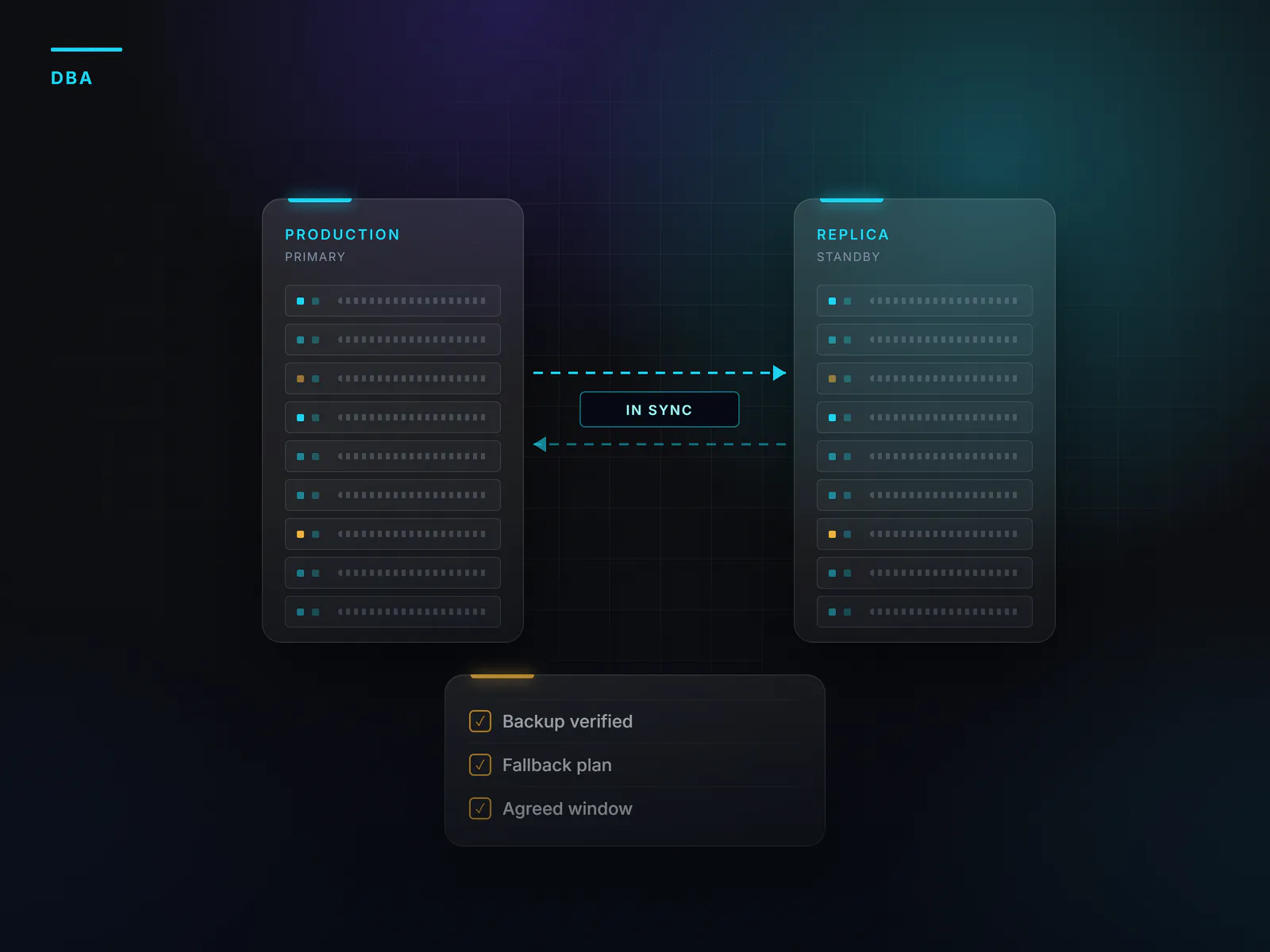
DBAAvailability Replication and availability A second server kept in sync, to restart quickly or to move heavy reads away from the main database.
DBAPerformance Performance and maintenance Slow queries, indexes, and the automatic clean-up of outdated rows (autovacuum) tuned to the real workload. We measure before and after.
DBAVersions

Version upgrades

From 13 or 14 to a supported version, tested on a copy with a planned way back. Versions and support dates
DBAMigration Migration from Oracle When it makes sense, with structure, data and code converted and tested on a copy before the move.

04 · copy the link to this sectionFrom Oracle to PostgreSQL

Migrating from Oracle to PostgreSQL: when it makes sense and when it does not

The first question always goes to the ERP vendor.

In short: it makes sense when your ERP allows it and when the licence savings outweigh the conversion and testing work. If the ERP runs only on Oracle, it usually does not.

It usually makes sense when

  • The application is yours, or its vendor also supports PostgreSQL.
  • Oracle licences weigh heavily and renewal is coming up.
  • There is little code inside the database (PL/SQL), or it can be rewritten.
  • You want to depend less on a single supplier.

It usually does not make sense when

  • The ERP vendor supports Oracle only.
  • The application uses many Oracle features with no direct equivalent in PostgreSQL.
  • There is no time to test everything on a copy before the move.
  • You are only after an immediate saving. Conversion and testing have a cost, and it belongs in the calculation.

To stay on Oracle with costs under control, see the Oracle databases page.

05 · copy the link to this sectionFor IT

From Oracle to PostgreSQL: the differences to prepare for

Conversion tools help, but they do not do everything. These items usually take the most work.

In OracleIn PostgreSQLWhat we do
PL/SQL code organised in packagesPL/pgSQL code, without packagesThe code is converted, reorganised and tested
An empty string counts as NULLAn empty string and NULL are differentWe check the queries that depend on it
NUMBER, and DATE that also holds the timeDifferent types, such as numeric, date and timestampWe choose the right type for each column
Names in upper case, unless quotedNames in lower case, unless quotedNames are made consistent before the move
Synonyms and optimiser hintsNot available in the same wayThey are replaced and slow queries are reviewed

The work that matters most is testing with the people who use the application, including month-end closing.

06 · copy the link to this sectionHow we work

How to migrate from Oracle to PostgreSQL with short, planned downtime

Five steps. Until the checks pass, Oracle stays ready.

Snapshot

Schemas, volumes, code in the database, connected applications, Oracle features in use.

Check with the vendor

If the ERP is not yours, you need confirmation that it runs on PostgreSQL.

Conversion on a copy

Structure, data and code move to a copy. The results of the main queries are compared.

Tests with the users

The functions that matter are tested with real data, including month-end closing.

Planned switchover

In the agreed window, with the way back to Oracle ready until the checks pass.

How long does it take?
It depends on volumes and the amount of code. The initial snapshot gives the timings.
How much does it cost?
There is no price list: it depends on volumes, code and testing. The first conversation carries no commitment. If there is work to be done, you receive a written proposal for the initial assessment, usually one or two days of work with the people involved. After the assessment comes the proposal for the project, with phases, timing and costs.

07 · copy the link to this sectionPrinciples

What we don’t do

  • We do not recommend a migration before seeing the code and the volumes.
  • We do not promise moves without downtime. Downtime is reduced and planned.
  • We do not leave you without a way back. Until the checks pass, the original system stays ready.
  • We do not keep scripts and procedures to ourselves. They stay with the company, documented.

08 · copy the link to this sectionFrequently asked questions

Frequently asked questions about PostgreSQL

PostgreSQL has no paid licence: who provides support?
The community that develops it publishes the fixes, but it does not look after company databases. Support comes from whoever administers them: an in-house DBA or an external service like ours. The cost is the work, not the software.
Is it worth migrating from Oracle to PostgreSQL?
It is worth it when your ERP allows it and when the licence savings outweigh the conversion and testing work. If the vendor supports Oracle only, usually not. The assessment comes first, on a copy.
When it makes sense and when it does not
How long is a PostgreSQL version supported?
Five years from its first release. PostgreSQL 14 receives fixes until 12 November 2026 and PostgreSQL 15 until November 2027. These are the dates published by the PostgreSQL community, consulted on 7 November 2026.
Does our ERP run on PostgreSQL?
Its vendor can tell you. If the software is yours, we check it ourselves on the code and on a copy of the data.
How much does PostgreSQL support cost?
It depends on how many databases, which versions, how much routine work and which projects. There is no price list. The first conversation carries no commitment. If there is work to be done, you receive a written proposal for the initial assessment, usually one or two days of work with the people involved. After the assessment comes the proposal for the project, with phases, timing and costs.

09 · copy the link to this sectionObservatory

From the Observatory: data and databases

Analysis and guides from the Strategic editorial team.

All articles on data and Oracle

The essential parts of this page print as a short summary of a few pages, without images or invitations to get in touch.

10 · copy the link to this sectionContact

Let’s talk about your PostgreSQL, or about leaving Oracle

A few lines: the version if you know it, the applications that run on it, what is wrong or what you would like to change. We reply by email, usually within two working days.

We work on site in San Marino, Romagna, the Marche and Emilia, and remotely across Italy. Where we work

Please do not enter passwords, server addresses or data extracts in the form: they are exchanged later, over the agreed channels.

On WhatsApp, messages are answered by Strategic’s AI assistant. Please do not use it for confidential information.

Your requestDBASQL Server, PostgreSQL and Oracle databases

Do any of these questions sound familiar? tick the ones that apply to you

The form opens with the topic and the questions already filled in.