Skip to content

STRATEGICRepublic of San Marino

Contact

Outsourced databases

Outsourced database administrator for Oracle, SQL Server and PostgreSQL

A DBA, or database administrator, keeps the database behind your ERP healthy: patches, backups, performance, access. We do it as an outsourced service for companies across Italy and in San Marino, remotely or alongside your in-house IT team. The scope and the response times are set out in the contract.

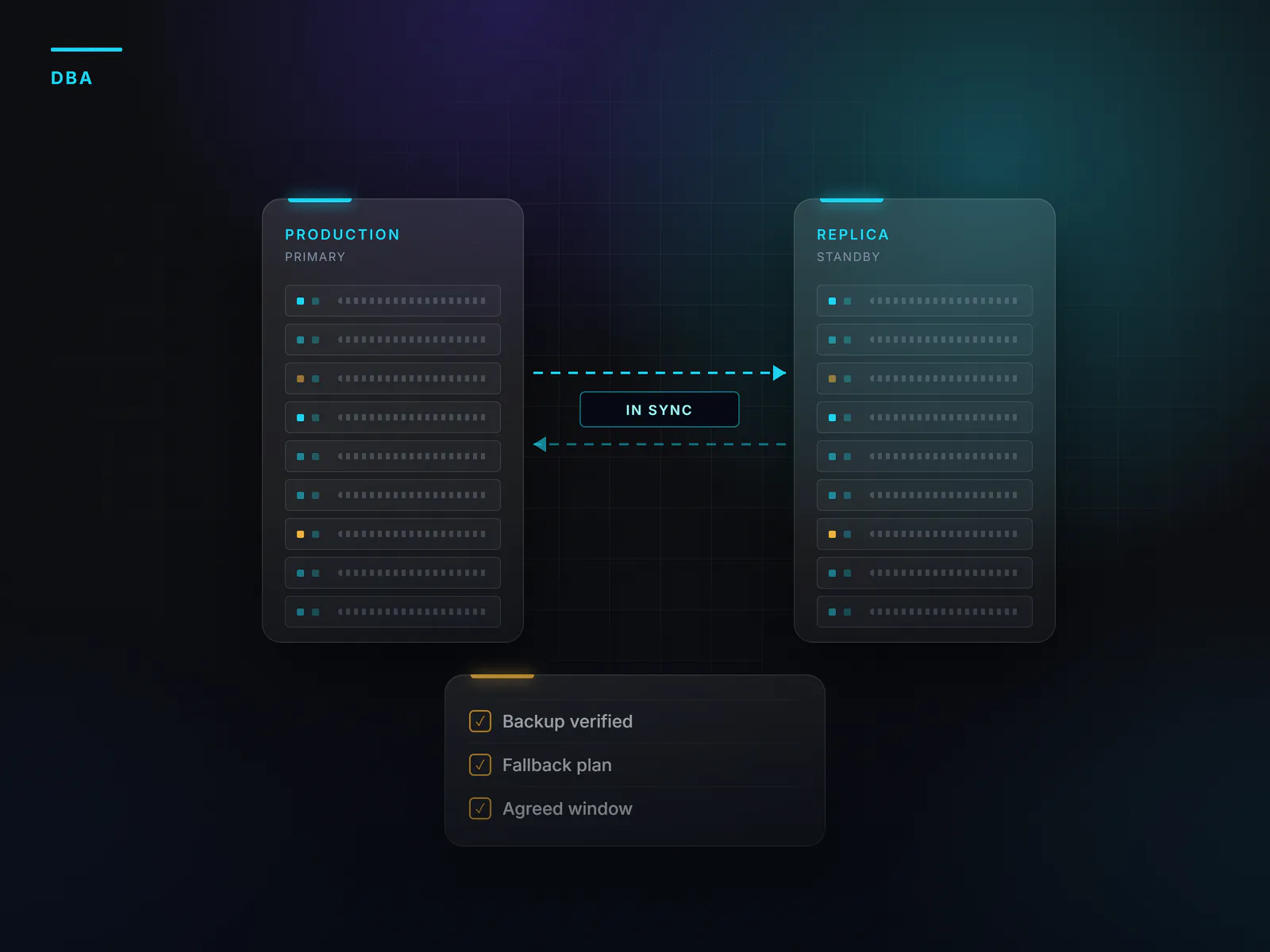
Example graphic: three databases, Oracle, SQL Server and PostgreSQL, each with its patch status, tested backups and end of support.
Example · the data shown is not real
Oracle, SQL Server, PostgreSQL
one method across different engines
Named, logged access
over the channel your IT team chooses
Tested recovery
scheduled restore tests, with the timings recorded

01 · copy the link to this sectionThe situation

There is more than one database, and nobody looks after all of them

The ERP on Oracle, accounting on SQL Server, the new application on PostgreSQL. Each has its own deadlines.

It happens a lot. The long-standing ERP runs on Oracle, a package bought later uses SQL Server, and the latest web application is built on PostgreSQL. Each engine has its own patches, its own versions reaching end of support and its own way of taking backups.

An in-house DBA rarely knows all three well. And when there is only one person, holidays and job changes leave the system behind orders and invoices without cover.

DBA

Different deadlines for each engine

Oracle, Microsoft and the PostgreSQL community each have their own support calendar.

DBA

Backups never tested

A backup that has never been restored cannot tell you how long recovery takes.

DBA

One person who knows everything

If they move on, their knowledge of the environment goes with them.

02 · copy the link to this sectionThe service

What an outsourced DBA service covers, and what it does not

The scope is written down before work starts. Anything not written down is not taken for granted.

In short: the retainer covers routine management of your databases, with a regular report. Version upgrades and migrations can be commissioned as separate projects, each with its own written proposal.

What it covers

  • Scheduled checks on space, errors, overnight jobs and data growth.
  • Patches and security updates on a schedule, tested first on a copy.
  • Backups with scheduled restore tests and a written record of the timings.
  • Users and permissions kept in order, with only the privileges needed.
  • Performance measured before and after every change.
  • A regular report and a yearly review of the environment.

What stays out unless it is written down

  • Changes to the ERP, which remain with its vendor.
  • Server and network management, unless it is in scope.
  • Licence negotiations with Oracle or Microsoft, which remain with the company.
  • Work at any hour. Emergency contacts and response times are the ones set out in the contract.

You can hand over everything, routine management only, or a single project.

04 · copy the link to this sectionRemote access

How remote access to your databases works, securely

Administering a database needs broad access. That is why the rules are agreed in writing before work starts.

  • Named accounts. Each person has their own account, with only the permissions they need. No shared accounts.

  • Connections agreed with IT. We use the channel the company chooses, and only towards the systems in scope.

  • Access is logged. Who connected, when and what they did is recorded and can be checked.

  • A written agreement. A non-disclosure agreement (NDA) before work starts. If the data is personal, the relationship is also set up under the GDPR.

  • Data stays where it is. No copy of the data leaves the company without written authorisation.

  • When the engagement ends. Access is closed and the documentation stays with the company.

Supplier and contractor access to company systems

05 · copy the link to this sectionWith your team

Alongside your IT department, not instead of it

An external DBA works with the people who already run your systems and follows their procedures.

Changes go through your internal procedures. Maintenance windows are agreed with the people who use the ERP, because they know the days when the system must not be touched.

Where there is already an in-house DBA, the work is split and written down. For example, your DBA handles day-to-day requests and we handle patches, backups and version upgrades. Or the other way round.

Configurations, procedures and test records are documented and handed over to the company, even if it changes supplier one day.

In-house or outsourced Oracle DBA: counting the hours you really need

06 · copy the link to this sectionThe first hours

Database down: what to do, and what to avoid

This applies to Oracle, SQL Server and PostgreSQL. The technical details are known to whoever administers the database.

Updated 7 November 2026

  1. Do not restart again and again. First keep the error messages and logs. They are needed to choose the fix.
  2. Stop whatever writes data. Suspend batch jobs and integrations, in agreement with whoever knows the application.
  3. Secure the current state. Before any attempt, take a copy of what is there.
  4. Tell the people who decide. Management knows how long work can stop and sets the priorities.

How to reach us: on a retainer, the contacts and response times in the contract apply. Otherwise, write to us through the form and choose «It’s urgent», or email staff@strategic.sm with «Database down» in the subject line. The form is not an emergency channel.

Corrupted Oracle database: what to do first, and why not to restart

07 · copy the link to this sectionHow we work

From the technical snapshot to ongoing management

Four steps, the same for Oracle, SQL Server and PostgreSQL.

Technical snapshot

Engines and versions, editions and licences, connected applications, existing backups, workloads. With read-only access and under an NDA.

Plan

Priorities and deadlines, maintenance windows agreed with the people who use the ERP, criteria for going ahead or rolling back.

Putting things in order

Urgent items first: missing patches, backups to test, accounts to close. Every change starts from a verified backup.

Ongoing management

Scheduled checks, patches on a calendar, restore tests, a regular report and a yearly review of the environment.

What does the company receive?
A technical document for the people who run the systems and a summary for management, with risks, costs and deadlines.
How much does it cost?
It depends on how many databases, which engines and versions, and how much routine work. There is no price list. The first conversation carries no commitment. If there is work to be done, you receive a written proposal for the initial assessment, usually one or two days of work with the people involved. After the assessment comes the proposal for the project, with phases, timing and costs.

08 · copy the link to this sectionPrinciples

What we don’t do

  • We do not promise migrations without downtime. Downtime is reduced and planned.
  • We do not touch production without a verified backup and a tested way back.
  • We do not use paid features the company is not licensed for, on Oracle or on SQL Server.
  • We do not promise response times verbally. The ones written in the contract apply.
  • We do not keep knowledge of the environment to ourselves. Procedures and configurations are documented and handed over.

09 · copy the link to this sectionFrequently asked questions

Frequently asked questions about outsourced DBA services

What does an outsourced DBA service cover?
Routine management of your databases: scheduled checks, patches on a calendar, backups with restore tests, users and permissions, performance. On top of that, a regular report and a yearly review. Version upgrades and migrations can be added as separate projects. The scope is written into the contract.
Does the external DBA work with our IT team?
Yes. Changes go through your internal procedures and maintenance windows are agreed with the people who use the ERP. If you already have an in-house DBA, the work is split and written down.
How does secure remote access to the databases work?
Through named accounts with only the permissions needed, over the channel your IT team chooses, with access logged. Before work starts we sign a non-disclosure agreement and, if the data is personal, set up the relationship under the GDPR. When the engagement ends, access is closed.
Do you also handle SQL Server and PostgreSQL, as well as Oracle?
Yes, for day-to-day support and for migrations. The method is the same: technical snapshot, plan, putting things in order and ongoing management.
SQL Server DBA
PostgreSQL support
Is it worth migrating from Oracle to PostgreSQL?
It depends first of all on your ERP. If its vendor does not support PostgreSQL, it is usually not worth it. If the application is yours, or is also certified on PostgreSQL, we compare licences, conversion work and risks. The trial happens first, on a copy.
Oracle to PostgreSQL migration
What happens if a database goes down?
On a retainer, the contacts and response times written in the contract apply. Otherwise, write to us through the form and choose «It’s urgent». Meanwhile, follow the first steps: no repeated restarts, no improvised repairs, a copy of the current state.
Database down: the first steps
How much does an outsourced DBA cost?
It depends on how many databases, which engines and editions, how much routine work and which projects. There is no price list that fits everyone. The first conversation carries no commitment. If there is work to be done, you receive a written proposal for the initial assessment, usually one or two days of work with the people involved. After the assessment comes the proposal for the project, with phases, timing and costs.
Do you work across Italy?
Yes. Databases are administered remotely, with access agreed with your IT team. On site, we work in San Marino, Romagna, the Marche and Emilia.

10 · copy the link to this sectionObservatory

From the Observatory: data and databases

Analysis and guides from the Strategic editorial team.

All articles on data and Oracle

The essential parts of this page print as a short summary of a few pages, without images or invitations to get in touch.

11 · copy the link to this sectionContact

Let’s talk about your databases

A few lines: which databases, which versions if you know them, the ERP that runs on them, any deadlines. We reply by email, usually within two working days.

We work on site in San Marino, Romagna, the Marche and Emilia, and remotely across Italy. Where we work

Please do not enter passwords, server addresses or data extracts in the form: they are exchanged later, over the agreed channels.

On WhatsApp, messages are answered by Strategic’s AI assistant. Please do not use it for confidential information.

Your requestDBASQL Server, PostgreSQL and Oracle databases

Do any of these questions sound familiar? tick the ones that apply to you

The form opens with the topic and the questions already filled in.