Vulnerability assessment and penetration testing: the difference explained for management
A vulnerability assessment lists known weaknesses. A penetration test shows what an attacker can actually do with them. They answer two different questions for management and do not replace each other.
A vulnerability assessment looks for the known weaknesses of systems and applications, mostly with automated tools, and lists them by severity. A penetration test tries to exploit them the way an attacker would and shows how far it gets. For management, the difference lies in the question. The first answers «what do we need to fix?». The second answers «what could really happen?». Neither replaces the other. A vulnerability assessment is repeated often and across the whole estate. A penetration test is carried out on the systems that matter, before a launch and after major changes.
Which question does each one answer?
The US NIST guide on security testing, SP 800-115, explains the limits of automated tools well. A scanner finds «surface» weaknesses, one at a time, by comparing how systems respond against a database of known flaws. It does not see the weaknesses that only emerge when several steps are combined. It can therefore rate each weakness as low risk, while together they open the way in.
This is exactly what a penetration test is for. The tester imitates a real attack, with the tools and techniques attackers use, and looks for the combinations that go furthest. It is manual work and requires experience, not least to avoid damaging the systems.
In practice:
- a vulnerability assessment is a wide snapshot. It tells you how many systems are missing updates, have weak settings or expose services that are not needed. It is quick and can be repeated often.
- a penetration test is a targeted trial. It tells you whether an outsider, starting from a given point, can reach client data, management email or the business software. It takes longer and is carried out on a scope authorised in writing.
Our guide on what a penetration test costs covers methods, types of test and what drives the price. Here we focus on the decisions management has to make.
Which one do you need, case by case?
The choice depends on the question management is asking. This table covers the most frequent cases.
| Management’s question | What you need | Why |
|---|---|---|
| Are we up to date? What has been left behind? | Vulnerability assessment | It covers the whole estate and is repeated regularly |
| Can an outsider reach client data starting from the website? | Penetration test | You need to try the combinations, not just list the flaws |
| A client asks for «your latest penetration test» | Penetration test on the scope the client cares about | A scan does not answer the client’s question |
| We are launching a new online application | Penetration test before launch | Fixing before go-live costs less than fixing in production |
| We changed the firewall or the network provider | Vulnerability assessment at once, penetration test if what is exposed changes | First check the configuration, then the real effect |
| We have just acquired another company | Vulnerability assessment of the acquired systems, then a penetration test of the connections | You also inherit what nobody knows about |
Which mix-ups cost the most?
There are five, and they show up often in quotes and reports.
- A scan called a penetration test. A report of hundreds of pages generated by a tool, with no attack paths and no evidence, is a vulnerability assessment. That is fine, as long as you know what you are buying.
- «No critical vulnerabilities» read as «we are secure». It means the tool found no known high-severity flaws, on that scope, on that day. Several medium weaknesses together can weigh more than a single critical one.
- A scope that is too narrow. The website is tested while email, suppliers’ remote access and the cloud are left out. The report looks good, the risk remains.
- Unchecked false alarms. Scanners use their own severity levels and also flag flaws that do not matter in context. Without verification, IT spends time on the wrong things.
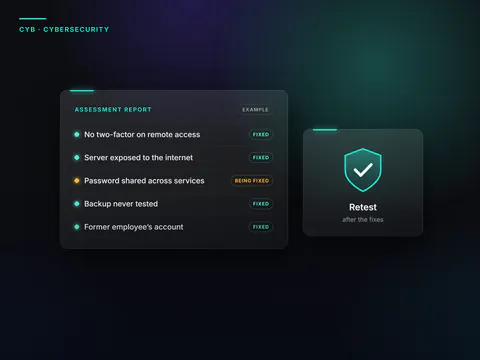
- A report left in a drawer. Without an owner and a date for each fix, and without a retest, the test has changed nothing.
What do the rules require?
Data protection law and NIS2 do not say which of the two tests to carry out in every case. They do, however, require you to check regularly that your measures work.
- Personal data. The GDPR (Article 32) and San Marino Law 171/2018 (Article 33) require a process for regularly testing, assessing and evaluating the effectiveness of security measures.
- NIS2 in Italy. Legislative Decree 138/2024 (Italy’s NIS2 law, Article 24) includes vulnerability handling and procedures to assess the effectiveness of measures. Among the documents that ACN, Italy’s National Cybersecurity Agency, lists for the baseline measures is a vulnerability management plan.
- Banks and insurers (DORA). Regulation (EU) 2022/2554 lists both vulnerability scanning and penetration testing among the tests (Article 25). It requires tests to be carried out by independent parties, internal or external, without conflicts of interest, and the issues found to be prioritised and their remediation validated (Article 24).
The exact frequency depends on the sector and the risk. The rules for the financial and payments sectors are described in our guide on the cost of a penetration test.
How should the board read the results?
The board does not need the technical pages. It needs five things, on one page.
- The scope. What was tested and what was not, over what period and from which starting point.
- The result in plain words. How far the testers got, or what is left to fix, with a concrete example.
- The priorities. Fixes ranked by their impact on the business, not only by technical score.
- Who and when. An owner and a date for each major fix. The retest is already in the calendar.
- The remaining risk. What you decide not to fix straight away, with the reason and the signature of whoever accepts it.
From one year to the next, the trend is what counts. A falling number of open issues and shorter fixing times say more than any single report.
In brief
- A vulnerability assessment lists known weaknesses. A penetration test shows what can be done by exploiting them.
- The first is repeated often across the whole estate. The second is carried out on key systems, before launches and after major changes.
- The costliest mix-ups are scans sold as penetration tests and «no critical issues» read as security.
- The GDPR, San Marino Law 171/2018, NIS2 and DORA all require regular checks that measures work.
- The board needs one page with scope, result, priorities, owners and residual risk.
Frequently asked questions
Can you start with a vulnerability assessment alone?
Yes, and it is often the right starting point. It gives you the list of things to fix and a remediation plan. A penetration test makes sense once the main fixes are done, on the systems that matter most.
Can the supplier that manages your systems carry out the test?
Better not. Whoever manages the systems tends not to see their own mistakes and has a conflict of interest in judging them. DORA explicitly requires independent testing in the financial sector. For everyone else it is a sound rule.
Who should receive the report?
Management receives the summary with the priorities. IT and the suppliers involved receive the technical detail that concerns them. The full report describes how to get into the systems. Keep it with restricted access, like any confidential document.
Is a new test needed after the fixes?
Yes, at least on the weaknesses that were fixed. The retest confirms that the fix works and has not opened other problems. DORA requires the financial sector to make sure every weakness found is actually resolved. For everyone, it is how the work gets closed.
Choosing the right test, setting the scope and following the fixes through to the retest is the work of our penetration testing and vulnerability assessment service. We work on a scope authorised in writing, remotely or on site. The report has a summary for management and the detail for IT.
Sources
Consulted on 7 November 2026.
- NIST, Special Publication 800-115, Technical Guide to Information Security Testing and Assessment
- EUR-Lex, Regulation (EU) 2016/679 (GDPR), Article 32
- Great and General Council, Law no. 171 of 21 December 2018, Article 33 (PDF, Italian)
- Normattiva, Legislative Decree no. 138 of 4 September 2024, Article 24 (Italian)
- ACN, NIS FAQs on baseline measures and notifications, FAQ MSB.11 (Italian)
- EUR-Lex, Regulation (EU) 2022/2554 (DORA), Articles 24 and 25
 Find out moreCybersecurityTesting carried out the way an attacker would (penetration tests), incident management, business continuity and support in meeting NIS2 requirements, suppliers included.