Opening an office abroad: the due diligence to complete before you sign
Counterparty, trade mark, sanctions, finances, people and security. These are the five checks a company should complete before opening an office or signing with a foreign partner, with the official sources to consult.
Before opening an office abroad, or signing with a local distributor or partner, a company must complete five checks. They cover the counterparty, the trade mark, sanctions and export controls, the finances and structure of the deal, and the people and security of the new office. They cost little compared with a bad contract, and they must be done before signing, not after the opening.
A typical scenario. A company decides to grow abroad. It opens an office, hires a local manager and translates its website. Six months later it finds out that its commercial partner is involved in an ongoing legal dispute. The IT supplier it chose does not comply with local data protection rules. And a competitor has already registered the trade mark in that country. No one had checked beforehand.
Why is international expansion a risk operation first of all?
Due diligence is the set of checks carried out on a counterparty, a market or a transaction before making a commitment. When a company expands abroad, it tends to start with what can be seen, such as the multilingual website, the trade fair and the first customer. These are the things shown to the board. But before every visible action there are invisible checks. If they are skipped, they cost far more than doing them would have.
International expansion is not a marketing project. It is an exercise in risk, finance and security. The translated logo comes at the end, not the beginning.
What are the five checks to make first?
| Check | The question it answers | Who does it |
|---|---|---|
| Counterparty | Who are you tying yourself to, and who really controls them? | Management, lawyer, external adviser |
| Trade mark | Is the name available and protected in that country? | Intellectual property adviser |
| Sanctions and exports | Can you sell that product to that customer, in that country? | Export department, lawyer |
| Finances and structure | Can the company sustain the operation, and with what tax effects? | Finance department, accountant |
| People and security | Who will run the office, and how will systems and data be protected? | HR, IT, employment adviser |
1. Who is really on the other side?
Before signing a distribution agreement, a joint venture or the purchase of a local company, you need an independent check on the counterparty. It covers these points.
- The country’s companies register, shareholders and directors
- The beneficial owner, meaning the person who actually controls the company
- The accounts filed in recent years
- Known litigation, insolvency proceedings and public news
- Verifiable references from customers and suppliers
The checks rely on registers, accounts, public lists and documents provided by the counterparty. They do not involve investigating individuals. Some signs deserve attention. Watch for a chain of companies running through several countries for no clear reason, requests for payment into accounts in a country other than the counterparty’s, and unusual haste to sign.
2. Is the trade mark available, and protected?
Trade mark protection is territorial. A trade mark registered in Italy is not automatically protected elsewhere. Many countries apply a “first to file” principle, so a distributor or a competitor can register the trade mark in its own name before the company that uses it. Before entering a market, it is worth taking these steps.
- Check that the trade mark is available in the target country.
- File it with the EU Intellectual Property Office (EUIPO) for the European Union, and through the international Madrid System run by the World Intellectual Property Organization (WIPO) for many other countries.
- Register the local domain names as well.
- State in the distribution agreement that the trade mark remains the company’s property.
3. Sanctions and exports: can you sell to that customer?
Two checks must be made before any agreement.
- International sanctions. Check whether the country, the counterparty or its beneficial owner is subject to European Union restrictive measures. The EU’s official sanctions map is the starting point.
- Dual-use items. Products, software and technologies that can also have a military use require an export authorisation under Regulation (EU) 2021/821. In Italy, authorisations are issued by UAMA, the export licensing authority within the Ministry of Foreign Affairs.
A recurring risk sign is an unclear end user, or a destination that changes during negotiations. The checks carried out must be documented and kept on file.
4. Can the finances support two offices?
Expansion abroad puts the parent company under pressure. Before committing capital, you need to know a few things.
- How much cash is needed, and for how long, before the new office can support itself.
- Whether the company can sustain both offices at once, even in the worst case.
- Which way into the market fits best, whether a local partner, a distributor, a representative office or an office of your own.
- What tax effects the choice has. An office, or even an agent with certain powers, can create a permanent establishment, meaning a taxable presence in the country. Assess this with your accountant before signing.
- How currencies, payment terms and payment security will be handled.
It is better to find a problem with the financial structure while the numbers are on the table than once the operation is under way.
5. Who runs the office, and how do you protect it?
People. The wrong local manager costs more than a year of activity. Speaking the language or knowing the market is not enough. The role must be defined first, with written objectives. The candidate must be assessed through verifiable references and in line with local employment law. This is the work described on our page on critical roles and succession.
Security. A new office brings new computers, new IT suppliers and new access rights. It must be protected like the head office from day one. On regulation, precision matters. NIS2, the EU directive on network and information security, generally applies to entities established in the European Union. An office outside the EU is not directly subject to it. But if the Italian company falls within NIS2, the new office’s systems connected to the corporate network are part of the risk to be managed. For personal data, transfers to countries outside the EU follow the rules in Chapter V of the GDPR, and the destination country may have rules of its own. How to set up protection is explained on our cybersecurity page.
What changes for a San Marino company?
San Marino is in a customs union with the European Union, based on an agreement of 1991. The association agreement with the EU, which will bring San Marino into the single market, is going through signature and ratification. What it changes for businesses is explained in a dedicated Observatory article. For San Marino companies the framework differs from Italy’s and needs to be assessed case by case, with the company’s own advisers.
Where does artificial intelligence help?
Artificial intelligence shortens the research. It can read registers and news in other languages, summarise long contracts, compare counterparties’ names against public lists and flag inconsistencies. The decision stays with the company, and every result must be checked against the source. An answer without a document is not a verification. Confidential negotiation documents should never be uploaded to public tools. How to use artificial intelligence on company documents, with sources cited and permissions defined, is explained on our page on AI consulting for businesses.
In brief
- Before signing, check the counterparty, the trade mark, sanctions and exports, finances and structure, and people and security.
- Register the trade mark in a country before entering it. In many countries, whoever files first wins.
- EU sanctions and dual-use rules are checked for every counterparty and every product.
- NIS2 does not apply directly to an office outside the EU, but that office’s systems are part of the company’s risk.
- For San Marino companies the framework needs to be assessed case by case.
Frequently asked questions
How long before signing should the checks begin?
Start as soon as the country and the counterparty have been identified, and in any case before negotiating the commercial terms. Some steps, such as filing a trade mark or obtaining an export authorisation, take time that is outside the company’s control.
Can a foreign distributor register the company’s trade mark in its own name?
In many countries it can, if it files first. To prevent this, register the trade mark before entering the market. State in the distribution agreement that the trade mark remains the company’s and that the distributor may not file it in its own name.
Does NIS2 also apply to the foreign office?
The directive generally applies to entities established in the European Union. Some categories that are not established in the EU but offer services there must designate a representative. An office outside the EU is not directly subject to it. But if the company is a NIS2 entity, the office’s systems connected to the corporate network fall within its risk management. For an office in another EU country, you also need to check the national rules by which that country transposed the directive.
Are checks needed even for a simple distribution agreement?
Yes. The distributor represents the company in the market, uses its trade mark and receives its goods. Counterparty, trade mark, sanctions and payment terms must be checked just as they would be for an office.
The checks in the right order, the ways into a market and the rules to verify are described on our page on international expansion. If your business already operates in a single country and you want to reduce your dependence on that market, see also our page Beyond a single country.
Sources
- EU Sanctions Map, the official map of European Union restrictive measures, consulted on 16 September 2026
- Regulation (EU) 2021/821 on dual-use items, EUR-Lex
- EUIPO, Where to register a trade mark
- WIPO, Madrid System (international registration of trade marks)
- Directive (EU) 2022/2555 (NIS2), EUR-Lex
- Regulation (EU) 2016/679 (GDPR), EUR-Lex, Chapter V
- European Commission, Access2Markets, EU-San Marino Customs Union, consulted on 16 September 2026
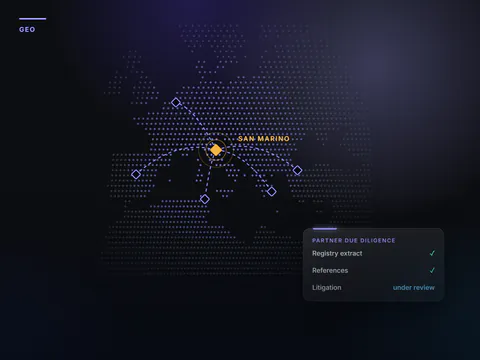 Find out moreInternational expansionChoosing markets, vetting foreign partners, security and people for the new office, and a plan so that you do not depend on a single country.