An AI assistant for executives: what to delegate, what to keep and how to choose one
Email, diary, reminders and documents. The repetitive work an artificial intelligence assistant can take off an executive’s plate, what stays with people, and how to assess one before you start.
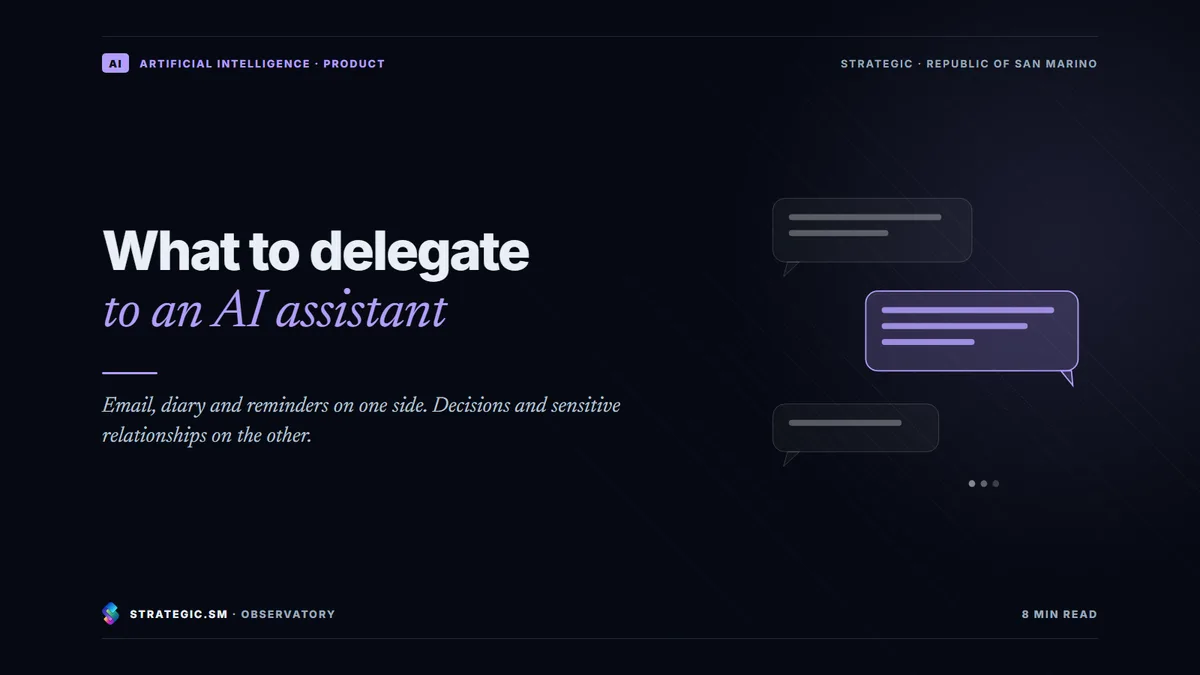
An executive can hand an artificial intelligence assistant the repetitive work that revolves around email, the diary and documents. That means finding an email, summarising an attachment, moving an appointment, remembering a deadline or drafting a reply. Decisions, sensitive relationships and anything that commits the company stay with people. Before you start, decide what access to grant, where the data ends up and what the assistant may do on its own. DIREKTA, the assistant developed by Strategic Labs, handles exactly this kind of work, on WhatsApp.
A typical scenario. It is 10.40pm. The managing director of a manufacturing company gets home after a day away from the office. He needs to move the nine o’clock meeting and reply to a supplier asking him to confirm an order. He also needs to pin down the key points of an afternoon meeting before he forgets them. None of this calls for a difficult decision. Together, though, it takes him an hour at the end of the day, when his attention is needed elsewhere.
What work piles up around an executive?
People who run a company spend the day in meetings, on visits and travelling. Meanwhile the inbox keeps growing. Among dozens of messages, the few that matter only come to light in the evening. A rescheduled appointment survives as a mental note. An attachment waits to be read at the right moment, which never comes.
Email, calendars and file archives are already in place. What is missing is someone, or something, to hold them together in spare moments, from a phone. The real cost is not the time any single task takes. It is the broken attention of the person who should be focusing on decisions.
What can you delegate to an AI assistant?
An AI assistant is a program that understands written or spoken requests and carries them out on the services it can access, such as email, calendar and files. The table shows what you can entrust to it, and with what care.
| Task | Can it be delegated? | With what care |
|---|---|---|
| Finding an email or an attachment | yes | nothing in particular |
| Summarising a message or a PDF | yes | check figures and deadlines against the document |
| Flagging only the messages that matter | yes | write the criteria down clearly |
| Moving or creating appointments | yes | confirm the outcome after every change |
| Reminders and to-do lists | yes | nothing in particular |
| Drafting replies | yes | reread them before they go out |
| Sending an email | only when explicitly asked | better a draft when the subject is sensitive |
| Signing, paying, accepting terms | no | these stay with people |
| Negotiations, staff matters, sensitive relationships | no | these stay with people |
One rule helps you find your way. Delegate what you can check in a few seconds. Keep what calls for judgement or commits the company.
What stays with the executive and their staff?
Decisions stay with them, first of all. So do the relationships with customers, shareholders, banks and colleagues, which rest on context and trust. So does the work of the people who support management, such as preparing an important meeting, handling a tense situation or reading what is not written down.
An AI assistant does not replace the secretarial team. It takes the repetitive work off their hands and helps the executive when they are out of the office or working outside office hours. It is worth making this difference clear to the people involved from the start, so that the tool is seen as help and not as a threat.
How do you assess an AI assistant before giving it your email?
Giving a program access to your mailbox is a serious decision. Six questions help you weigh it up.
- What access does it ask for? Check which mailboxes and calendars it reaches, whether it can only read or can also write and send, and how the authorisation is revoked.
- Where does the data end up? Find out where the servers are, which other providers process the text and how long it is kept. With personal data, you need a contract with the provider that processes it on the company’s behalf (GDPR, Article 28).
- What does it do on its own? A good assistant does not contact anyone on its own initiative. It writes to third parties only when its user asks, or to reply to someone who has written to its number. The rules on what it may say in reply are decided in advance.
- How are mistakes caught? AI models can be wrong with apparent confidence, for example by attributing to a document a figure it does not contain. Summaries and drafts must be checked, and the actions the assistant has taken must stay visible.
- Who talks to third parties, and how does the assistant introduce itself? If the assistant replies to customers or suppliers, a European rule applies from 2 August 2026. The EU Artificial Intelligence Act (AI Act) requires systems that interact with people to tell them they are dealing with artificial intelligence, unless this is obvious (Article 50).
- Does it work with the services you use? The company’s email and calendar must be supported. Check this before making any commitment.
How does DIREKTA work?
You use DIREKTA on WhatsApp, the way you would message a colleague, with a text, a voice note, a photo or a document. Here is what it does.
- Email. It searches every folder without marking messages as read. It summarises, finds emails and attachments, reads PDFs, prepares drafts and sends them when asked.
- Targeted alerts. You tell it in plain words what to watch for, such as a payment confirmation, and it alerts you only in those cases.
- Diary. It creates, moves or cancels appointments from a sentence or a voice note.
- Reminders and lists. The reminder arrives on WhatsApp at the time you set.
- Voice notes, photos and documents. It understands voice notes and reads photos of documents. The files it receives are kept in a searchable archive.
- Memory. It remembers preferences and recurring information.
- Web dashboard. You link WhatsApp with a QR code and manage mailboxes, calendar, alerts, the archive and the record of completed actions.
Today it connects to Zoho Mail and Zoho Calendar, including several mailboxes. For other services, compatibility is checked before activation. It runs on a dedicated WhatsApp number, with the data on servers in the European Union. That number can also receive messages from customers and suppliers. How DIREKTA should behave with them is decided at activation, and the AI Act transparency rule mentioned above applies to third parties. To understand requests, it uses artificial intelligence models from third-party providers, which are listed in the privacy notice.
What does DIREKTA not do?
- It does not contact anyone on its own initiative. It writes to third parties only when its user asks, or to reply to someone who has written to its number.
- It does not send messages to contact lists.
- It does not sign, pay or accept contracts.
- It does not mark the emails it consults as read.
- It does not replace your email, calendar or ERP system. It works on top of them, and the data stays in the original systems.
- It does not make phone calls or take part in meetings.
When do you need a personal assistant, and when a Company Brain for the whole organisation?
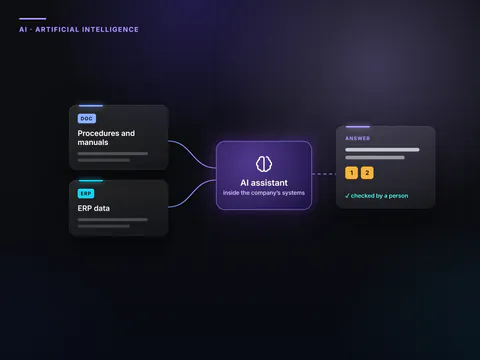
DIREKTA is a personal assistant. It works on the email, diary and files of the person who uses it. Sometimes the same need extends to departments and sites. People need to find procedures, documents and ERP data, each with the permissions of their role. That calls for a different project, a Company Brain for organisations, the company’s own searchable memory. For customer messages on the company’s WhatsApp, there is instead a chatbot that replies and never writes first.
DIREKTA is subject to the same rule we apply to all our products. When it is one of the options, we say so and compare it with the alternatives, as explained in the three questions to ask before signing an AI project.
In brief
- You delegate to an AI assistant the repetitive work on email, diary, reminders and documents.
- Decisions, signatures, payments and sensitive relationships stay with people.
- An AI assistant does not replace the secretarial team. It takes repetitive work off their hands.
- Before you start, assess access, where the data is stored, autonomous actions, how mistakes are caught and transparency towards third parties.
- DIREKTA works on WhatsApp, with email and calendar connected and servers in the European Union. It writes to third parties only when asked, or to reply to someone who has written.
Frequently asked questions
Does an AI assistant replace the secretarial team?
No. It takes part of the repetitive work off the executive and the people who support them. That covers searches in the inbox, reminders, diary changes and first drafts. Relationships, context and sensitive situations stay with people.
Can DIREKTA send emails on its own?
It sends an email when you ask it to. If you prefer to check first, you ask it for a draft, which stays in the mailbox until it is sent. Email alerts go only to the person who uses it.
Which email services does it work with?
Today it works with Zoho Mail and Zoho Calendar, connected through an authorisation from the dashboard, including several mailboxes. For other services, such as Gmail, compatibility is checked before activation, during the demonstration.
How much does DIREKTA cost?
DIREKTA is offered as a subscription. The terms are presented together with the product, based on how many people will use it and which connections are needed.
Features, limits and data handling are described on the DIREKTA page. To see how it fits the way you work, with the email services you already use, you can request a demonstration.
Sources
Consulted on 16 September 2026.
 Find out moreArtificial intelligence for businessesArtificial intelligence built into the systems your company already uses. We choose the right processes, connect the data, and settle security and rules first.