Can the company selling you AI also advise you? Three questions before you sign
The firm that proposes an AI project often builds and runs it too. That is not a problem if it is declared. Here are three questions to ask before you sign, and the signs of a serious proposal.
A firm that sells an artificial intelligence project can also advise on it, on one condition. It must say so openly, and it must accept comparison with alternatives judged on the same criteria. The dual role is not the problem. The problem is when it stays hidden. Before you sign, three questions are enough to understand what you are buying. Who profits from the answer? How do you get out? Where does the data go, and who uses it? The answers, and the way they are given, say a great deal about the project and the vendor.
A typical scenario. A company’s management receives an ambitious proposal. It is an AI assistant for the sales team, built on a bespoke platform, with an annual fee and usage-based charges. The same firm carried out the needs analysis and wrote the proposal. It will also build the system and run it for years. The demo was convincing. But no one in the room can say whether the project is really needed, whether simpler routes exist, or what happens if the company wants to change vendor in two years’ time.
Where does the conflict of interest in an AI project come from?
A conflict of interest arises when the adviser gains financially from the choice they recommend. It is common in artificial intelligence projects, because the same firm often plays three roles.
- It makes the diagnosis, deciding where AI is useful and where it is not.
- It builds the solution, with its own tools or its partners’ tools.
- It runs the solution over time, through fees, licences and model usage.
Each of these roles comes with an incentive. Whoever builds tends to propose something to build. Whoever runs the system prefers architectures that only they know how to run. No bad faith is needed. The revenue model steers the answer.
The answer is not to look for an adviser who sells nothing. It is to demand transparency. Strategic also develops and distributes software that uses artificial intelligence, such as DIREKTA and Kristina Reply. That is why the rule we apply is written down. When one of our products is among the options, we say so and compare it with the alternatives on the same criteria. In our second opinion on AI projects and vendors we do not propose our own products.
What are the three questions to ask before signing?
First question: who profits from the answer?
Ask the vendor how it is paid. It could be a fixed fee, a subscription, a share of model usage or commissions from other suppliers. Then ask to see at least one alternative, assessed on the same criteria. That could be a different tool, a simpler solution or sometimes the licences the company already has. “Do nothing for now” is a legitimate alternative too. A serious vendor has no problem putting it on the table.
Second question: how do you get out?
An artificial intelligence system is not just software. It also includes the uploaded documents, the configurations, the instructions given to the model, the indexes built on the data and the conversation logs. The right question is this. If the relationship ends, what comes back to the company, in what format, how quickly and at what cost?
In the European Union, the Data Act sets minimum rules for switching between providers of cloud services and subscription software. It does not cover everything that is custom-built, though. The exit clause still has to be written, and the clauses worth reading are the subject of a dedicated Observatory article.
Third question: where does the data go, and who uses it?
Ask in which countries the data is processed, which other suppliers are involved and how long the data is kept. Ask too whether it can be used to train the vendor’s models, in other words to improve them with the company’s content. If the data includes personal information, the GDPR requires a contract with the supplier that processes data on the company’s behalf (Article 28). It also sets precise rules for transfers outside the European Economic Area (Chapter V). All of this must be written into the contract, not just said in a meeting. For San Marino companies the legal framework is different and needs to be assessed case by case.
What should an AI project adviser be able to do?
They need to do three concrete things.
- Understand processes before tools. That means seeing where time is lost, where mistakes happen and where information cannot be found. Some processes should not be automated, and saying so is part of the job.
- Assess the architecture. Where does the system read its data from? How does it connect to the ERP system and the archives? Which model does it use, and can that model be replaced? How are permissions protected?
- Read the contract alongside the company’s lawyer. The clauses on data and exit have technical consequences. Both kinds of expertise are needed, and the legal assessment stays with the lawyer.
Someone who can do only one of these things may be an excellent vendor. They are not the right person to advise on the choice.
Why start from the company’s knowledge rather than the interface?
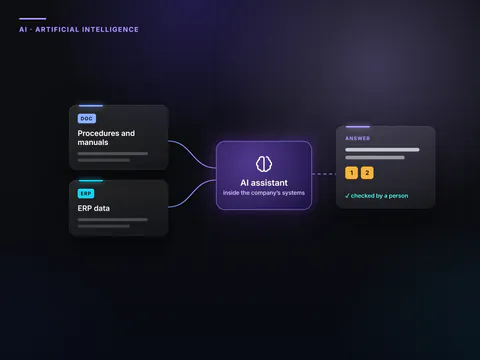
Many proposals start from what you can see, the window where you type the question. The value lies behind it, in the content the assistant draws its answers from. That means procedures, manuals, contracts, past quotes and ERP data. If these are scattered, duplicated and kept in different versions, even the best model will answer badly.
That is why the soundest projects start by organising the company’s knowledge. Which documents are valid? Who updates them? Which departments can consult them? This is the work of our Company Brain for organisations, the company’s own searchable memory. Every answer shows the current document it is based on, and permissions follow the role of the person asking. A proposal that says nothing about this part is selling an interface, not a system.
How do you recognise a serious proposal?
Good signs
- A written scope, stating what is included and what is not
- A trial on the company’s real documents, with success criteria agreed in advance
- Costs estimated over several years, with the assumptions stated
- Clear roles, showing who does what on each side
- A willingness to say that part of the project is not needed
Warning signs
- Pressure to sign by a set date
- Demos only on data prepared by the vendor
- Vague answers on exit and on how the data is used
- A clear price for the first year only
In brief
- A firm selling an AI project can advise on it, if it says so and accepts comparison with alternatives.
- Ask three questions before signing. Who profits from the answer? How do you get out? Where does the data go, and who uses it?
- EU rules on switching providers do not cover everything, so the exit clause must be written anyway.
- Sound projects start from the company’s knowledge, not from the interface.
- A serious proposal has a written scope, a trial on real data and costs estimated over several years.
Frequently asked questions
Can an adviser who also develops software be impartial?
They can, if they declare their own products, compare them with the alternatives on the same criteria and leave the choice to the company. When you need an assessment with no interest of any kind behind it, choose an engagement in which the adviser commits in writing not to propose their own solutions.
Do you need a lawyer to read an AI contract?
Yes, for the legal side. But many clauses have technical effects, such as data formats, server locations and usage-based costs. The lawyer should work together with someone who knows the system’s architecture.
What happens to data uploaded during a trial?
It depends on the trial terms, which often differ from those of the final contract. Before uploading real documents, ask in writing where they will be processed, how long they will be kept and whether they can be used for training.
Is it worth starting with a pilot project?
Usually yes, if it has a limited scope, real data and success criteria written down in advance. A pilot without criteria is just a longer demo.
Reading the proposal, the architecture and the contract before signature, alongside the company’s lawyer, is the work of our second opinion on AI projects and vendors. If the project goes ahead, the same questions become practical work in our artificial intelligence services for organisations.
Sources
Consulted on 16 September 2026.
 Find out moreArtificial intelligence for businessesArtificial intelligence built into the systems your company already uses. We choose the right processes, connect the data, and settle security and rules first.